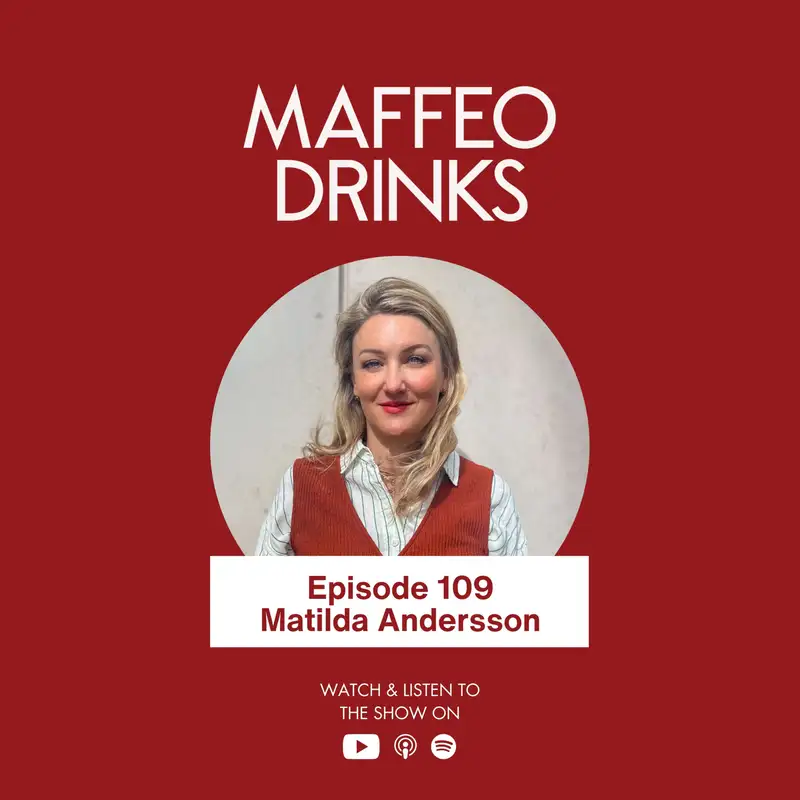
The Trend of Ignoring Trends: How Matilda Andersson Uses Ethnographic Research to Uncover Real Consumer Insights in Drinks | 109
Summary
In this episode of MAFFEO DRINKS, host Chris Maffeo speaks with Matilda Andersson, Managing Director at Truth Consulting, about transforming how drinks brands approach consumer insights and market research. The conversation explores why traditional focus group research fails to capture authentic consumer behavior, and how ethnographic research (observing people in bars, homes, festivals, and unexpected locations) reveals the cultural truths that drive brand success. Matilda introduces "the trend of ignoring trends," explaining the critical difference between fast-moving fads (TikTok dances, viral flavors) and slow-changing cultural fundamentals (rituals, occasions, social connections) that brands should actually focus on. We examine the premium positioning trap where every brand claims to be premium, creating bland homogenization rather than differentiation. The discussion challenges conventional wisdom about Gen Z drinking habits, revealing they're drinking differently rather than abstaining, and explores why generational commonalities matter more than manufactured differences. Why occasions and rituals as more valuable strategic frameworks than demographic targeting, showing how brands must earn relevance in existing consumer moments rather than creating artificial ones. Key topics include participant observation methodology, brand self-awareness, cultural rituals in modern context, qualitative research integration with quantitative analysis, and how brands can actively shape culture rather than passively follow trends. Timestamps : 00:00 - Introduction: Insights, Rituals & Cultural Role of Drinks 02:15 - Matilda Andersson Background: Career in Consumer Insights & Drinks Industry 05:30 - Cultural Role of Drinks: Historical Context & Modern Rituals 08:45 - The Trend of Ignoring Trends: Fast vs Slow Cultural Change 12:20 - How Brands Can Differentiate What's Worth Pursuing 15:40 - Brand Self-Awareness & The Premium Positioning Trap 19:10 - Understanding Your Brand's Core vs Chasing Competition 22:35 - Probable Futures: Active Cultural Participation vs Passive Reception 25:50 - The Spritz Example: When Trend-Chasing Goes Wrong 28:20 - What is Ethnographic Research? Definition & Methodology 31:15 - Real Insights Happen at the Bar (and McDonald's) 34:25 - The Laziness Problem: Why Brands Don't Observe Enough 36:50 - Gen Z Drinking Myths: They're Drinking Differently, Not Less 39:20 - Generational Commonalities & Occasions Over Demographics 42:10 - Wrap-up: Key Takeaways on Cultural Insights & Ethnographic ResearchThis is A Fare Drinks.
Matilda Andersson:I actually love how you're talking about, you know, insights happen at the bar. I that for me is ethnography, you know. It's the, you know, the insights of what people are up to isn't happening in a focus group facility with a double sided mirror, you know, what people are up to is happening at the bars. But it's also happening in their homes, on the picnic, on their commute, you know, on a Sunday dinner.
Chris Maffeo:In this episode, I'm joined by Mathilde Anderson, managing director at Truth Consulting. With her, we talk about the trend of ignoring trends. So something that she wrote in a previous article and, really caught my attention. In this episode, we talk about, ethnographic research, the importance of ethnographic research. We go into my approach of, you know, getting and gathering insights, sitting at the bar, observing consumers, and how to ground it with a with a better and more robust, quantitative analysis.
Chris Maffeo:We build on some of the discussions that I've also had with Paul Thomas in, in previous episodes. We also talk about the framework of the four c's. And, we talk about, you know, Gen z and boomers, and are they really different as many article talk about or actually not really? I don't want to spoil the episode, so let's dive in now. Hi, Matilda.
Chris Maffeo:Welcome to the Mephurgics podcast.
Matilda Andersson:Hi. Great to being here, Chris.
Chris Maffeo:We realized that we have a common city in our in our past, Stockholm.
Matilda Andersson:In our past and and in our heart.
Chris Maffeo:Yes. So but we I think we didn't we didn't we didn't bump into each other back in the days.
Matilda Andersson:No. I think I I'm I've lived in London now for twenty five years, but I'm I'm from Stockholm. And, yeah, go go back a lot. Love Stockholm a lot.
Chris Maffeo:Fantastic. So let's start. Like, tell us a little bit about you and what you what you do. And, and then I'll start asking you some, some interesting questions for our listeners.
Matilda Andersson:Cool. Yeah. I've I've worked in in insights and research all my life. All my career, I've been finding out what people are into, what's happening in culture to help brands show up in more meaningful way for people, for their customers. And I'm extremely passionate about helping brands be culturally relevant and consumer centric.
Matilda Andersson:So I think a lot of people kind of say that they just like fell in to working in market research. I think I'm quite like, it's really like where I want to be. It's where I've always wanted to be. And I've in that career, in my journey, I've been able to work for brands like the BBC and work for agencies and had the opportunity to work for a lot of drinks brands. So I've been doing work, you know, insider, in beer, in whiskey, a lot of whiskey, rum.
Matilda Andersson:And it's so fascinating because drinks just play such an important part in culture and in people's lives.
Chris Maffeo:And this is a fantastic point of what you're bringing because I was discussing it just like recently with Ben Branson, for example, from, you know, and Silva and and Season Now. The fact that, you know, like, we tend to lee I mean, drinks well, yeah, we don't see the drinks as a category, but, actually, you know, there is a a for right or wrong, you know, plays a role in culture. You know, there's all the trend about, you know, drinking less and are people drinking less or not. But, you know, the fact that actually it is a historical I mean, I'm a big history lover, and one of the reason why I love working with drinks is not necessarily for the drinks themselves or the for the for the categories themselves, but it it is because they play such a role in in culture historically, that, you know, they are part of everyday life for a reason. I mean, if we take the Oktoberfest, it's, you know, it's a feast for, you know, celebrating and thanking god for, for the harvest.
Chris Maffeo:You know? It's a it's a harvesting, celebration, you know, that then becomes a cultural phenomenon and people tend to forget that. But, you know, it always starts with that, you know, the you know, I mean, here in Czech Republic, but in Italy as well, all this wine, you know, wine harvest, all these festivities about wine and and so on, you know, and then it goes to whiskey and and and so forth. But Yeah. We we tend to forget this cultural element and we play and correct me if I'm wrong, like in my assumption, but we tend to play, we try to stick it back to a cultural aspects, but in modern culture, forgetting the traditional elements of of this cultural element.
Matilda Andersson:Yeah, absolutely. And I think, I mean, it's we talk a lot about, you know, habits, ritual in our work, in insights. And I think that kind of, you know, so rituals are important, like how we come together and, you know, whether it's kind of, you know, the Friday night drink or, you know, the Sunday kind of dinner with everyone around you and kind of the social connection and the rituals around drink. I think we tend to forget in modern culture, but it's still those things aren't going away. They're enormously important for how people live their lives and feel part of something.
Chris Maffeo:Absolutely. Absolutely. And, you know, I like to segment it in my own frameworks in kinda like traditional occasions and modern occasions. No? You know, there is always this element.
Chris Maffeo:I mean, if we take Peroni as an example as a common element, you know, there is there will always be this element of having Italian food or a pizza or an aperitivo with an Italian beer, you know, that will never leave that real kind of thing. Then you can also have it on a skyscraper in Burj Al Arab in Dubai, you know, or in a, you know, in a fancy cocktail bar in Stockholm. But that element of an Italian restaurant serving an Italian beer will never leave. And we we we often tend to forget that by jumping on what's trendy. You know?
Chris Maffeo:And and this is like some some of the conversation I want to have with you is about this element of trends. And and I remember you, you know, I read an article from from you on the drum, and you were mentioning the fact that, you know, I I love that quote. It was like the trend of ignoring trends. You know? And that struck with me because I was like, you know, what's this?
Chris Maffeo:Because, you know, like, I'm you know, sometimes I'm obviously, I want to see what what is trendy, but then often I I'm also very much against trends and like, okay. Let's stick to the foundations and let's not jump left and right. So what you know, can you explain what you what what what you mean by the the trend of ignoring trends?
Matilda Andersson:Yeah, absolutely. I mean, that article creates a little bit of a stir in the trends industry, as you can imagine. I mean, some of the smartest people that I know work in trends and I'm a big fan, but I think there is a danger of kind of focusing too much on. And I think actually it goes back to what you were talking about traditional and modern occasions or culture. I think some things are happening fast and some things are kind of changing slowly.
Matilda Andersson:So I think just looking at things, you know, the latest food truck or the latest dance that's become popular on TikTok, it's loses its meaning. It's just something that's here one day and gone tomorrow. You know, so it's about having a long term and a short term perspective because, you know, the kind of the fundamental cultural shifts that are have enduring impact on people's lives, than just kind of jumping on and to kind of copying what other people are doing, because it's just something that's happening. It's a happening rather than something that is worth really spending your efforts on.
Chris Maffeo:And how, you know, how can brands, you know, kind of like differentiate or like decide on what is actually, like, something worth jumping on or something that is actually okay. That that's trendy, but, you know, let's leave it to whatever, competition or or other categories that, you know, is not really something worth pursuing.
Matilda Andersson:Yeah, such a good question. And actually, lot of clients, they come to us because they have trends. Like they've already, you know, a lot of them have trends frameworks. So they've kind of, they spotted trends, but they're like, what are we gonna do with this? Like, what does this actually like mean?
Matilda Andersson:And I think it is about what does it mean for you? Like, what does it mean for you as a brand? What does it mean for your portfolio? And a lot of that kind of not feeling overwhelmed by all these things going on and the trends happening is about looking inwards and figuring out what you're all about. What is the vision for your brand or what is the strategy within your portfolio of brands?
Matilda Andersson:Where are you trying to play and where have you got permission to play within what's happening in culture? So it's about going back to what you're all about really.
Chris Maffeo:And do you feel that, you know, like many brands, you know, kind of like lack the stability on, you know, like the of, okay, what's the core of what my brand stands for? And then, okay, let's, you know, get all this noise, but, you know, like, just, like, passing by me. And then I just stick to it because I want to focus for the long term what the brand, what I believe my brand stands for. Or do you think that there is this kind of like friction and, you know, going left and right on brands? And I'm not talking about your clients.
Chris Maffeo:I'm talking about in general, what you see companies doing in in business.
Matilda Andersson:Yeah. I mean, I think there's a kind of there's a tendency to always be trying to find the next big thing. And in that, I see a lot of kind of chasing the next flavor or ingredient or kind of cultural phenomena, like the video that just gone viral, but it does end up being a little bit of a mess because you're just doing, you're just looking the same. And I think one good example of that is brands, everyone wanting to become more premium and the kind of the premiumization. But actually what we've ended up with is like a really bland space where all brands look the same without any differentiation.
Matilda Andersson:Everyone is sitting in brand strategy meetings saying that they want to be premium, but it's like, but you all just look the same. So I think that's the kind of always a good example where there's like, you know, a trend and and a kind of me to think in in strategy.
Chris Maffeo:And I see I mean, I I was smiling because I I see this a lot. I mean, I, you know, whenever I'm sitting in meetings, but even my past when I was, you know, working with brands myself, there there's always this kinda like, I mean, if you if you were to you know, you couldn't admit that your brand was not premium. No? So then it was just, you know, that there was this creation of terminology like upper mainstream or lower premium or, you know, because you knew that your brand has nothing to do with premium. You know, you wish, you know, like it's like you you wish to be cool, but you're not cool.
Chris Maffeo:So it's like, you know, like, wanna be cool. You know, it's like a wanna be premium sometimes rather than premium. And and there is this element that, you know, if you don't make your own kinda like self assessment and you can look at yourself in the mirror and say, okay, I'm not premium. You know? My brand is not premium.
Chris Maffeo:There's nothing wrong with it. You know? I can make billions by not being premium and by being mainstream. And let's face it and let's just like be honest with ourselves. Do you think that there's something about, let's say, self awareness of, you know, knowing what your brand stands for and admitting what your brand stands for?
Matilda Andersson:Yeah, I think there's a kind of, there's a really important, you know, if you're going to go on a journey of really understanding what your customers are into, what's happening in culture, you need to do that with the grounding and what you're all about. It's kind of like when you're going to, with any relationship, know, in a relationship you kind of don't wanna lose yourself in the relationship. And I think kind of deep work of really understanding customers and understanding what's happening in culture and what role you want to play in the category to actually have anything meaningful come out of that. So much about figuring out who you are in that relationship.
Chris Maffeo:And building on this, like building on this, there is this element of kinda like dichotomy between what you let's say, what a brand stands for today versus what you would like it to be. Uh-huh. So very often when I'm sitting in meetings or talking to brand owners, it's not much with brand owners. I would say more like brand managers of existing brands. Now there's always this rejuvenation and the premiumization and what we discussed before, but, you know, there is this element of understanding, okay, you know, who is actually drinking your product and who would you like to drink your product?
Chris Maffeo:No? And in the PowerPoint, you show me in a in a meeting room, you know, I've I've never seen those people drinking your product. Sorry. You know, sorry for the wake up call, but, you know, like, I've never seen them. You know?
Chris Maffeo:So if you go to the supermarket or if you go to the bar, you will see the real people. No? So there is this element of understanding what's in the present, which is probably the source of business that are people buying your product and who you would like to become consumers, shoppers, and so on. So how can you help, you know, brands kinda like, you know, understand these probable futures, you know, like rather than yeah, how how do you my question, like, let me rephrase the question. Like, so how do you, you know, how can you help brands identify these probable futures for themselves?
Matilda Andersson:Yeah, it's really, really good question. And I think, I mean, the thing about, you know, there's that gap between who your customer really is versus who you want to go after. I mean, I think there is an element of it's okay. You want a little bit of halo effect. So you kind of having a bit of a sweet spot of who you're kind of ideal customer is, then, but I think it's important not to exclude people and also under, and we talked a little bit about boomers in our, only in previous conversations and it's about, you know, kind of, yeah, older people are, do actually exist, first of all.
Matilda Andersson:You know, in market research, you kind of capped a lot of research at like 55 plus, like the people above, there are people in the world who are older than 55 and they do consume your product and they actually don't consider themselves to be old. So, you know, can you just think about that because, you know, there's a lot of amazing people like Kate Moss is a boomer, right? So I think it's like kind of, yeah, definitely like, you know, who's actually, like don't exclude people in that way because there's an amazing opportunity to speak to your actual people. And I think, you know, it's not just about consumers, it's about, you know, people don't consider themselves to be consumers of your brand. They consider themselves to be, you know, they're people most all of the time and only consumers some of the time.
Matilda Andersson:But I think
Chris Maffeo:That's true.
Matilda Andersson:I think with probable futures that the brand should focus on, it's about, you know, I think sometimes we kind of trends work. We think about trends and then what we should do about the trends. But I think it's about brands also figuring out what role they want to play in culture. So, it kind of, you know, it's about, you know, what values do we have? How do we want to, what do we want the future to look like?
Matilda Andersson:So when we do scenario work and understand possible scenarios that might happen, it's like, okay, so if we have six different scenarios what the future might look like, you as a brand have an opportunity to shape those, you know, go for the scenarios and try to shape them and make sure that they happen, if that makes sense. So it's not just about possibly receiving what might be the future. It's about playing an active role of what you want the future for your brands and how you want to show
Chris Maffeo:up in the future. If I understand correctly, this element of, like, the probable future, let's say, know, that let's say, does it still play a role in this let's say, does this self awareness that we discussed before play a role in it? Because, you know, I feel that very often brand owners or managers, they still don't give up on their dream. No? So it's kinda like how do you set the line between like, sorry.
Chris Maffeo:This is this is a dream. It's never it's very probable that it's never gonna happen. Or, you know, okay, let's fight with all the strength we can to make that happen. You know? Yeah.
Chris Maffeo:Like, what what what do you see? You know? Like, do do you see in in your everyday life, you know, do you see people are kind of like really realistic about their brands or because I'm asking you these questions because I feel what we were discussing before now that's very often everybody jumps on the same trend. No? I give you a real example so for for the listener to make it simpler to to follow, the spritz.
Chris Maffeo:You know? Spritz is a typical example where you would have end countless reports or trends and, you know, Spritz is growing and everybody wants to do Spritz and every deck probably has an Aperol case study of how they did something and so on. But then it's like, okay. But you have a rum brand. You know?
Chris Maffeo:So what what are you gonna do about it? You know? And is your brand suitable in a kind of like spritz occasion, or is it like, I don't know, like a 55% alcohol by volume and it's never gonna be, you know, easy drinking, aperitif. And also sometimes, like, I I see the owners and brand managers like jumping on something just to make it happen. So it's like the rum spritz, the whiskey spritz, you know, like the now I'm I'm actually reading, you know, but you know what I mean?
Chris Maffeo:Like, you know, anything spritz or anything and tonic or anything and grapefruit juice or anything with ginger ale. You know, it's like, how what is your experience in in basically being self aware and say, okay, like this is the trend, we acknowledge that this is a trend, but we want to stick to certain things Absolutely.
Matilda Andersson:I mean, I don't know how many briefs I've seen. We, you know, what's the next Aperol spread, you know, like how can we eat into that moment? I absolutely, and I think it's that in a ways where you kind of you hone in too much on what your competitors are doing, you know, what's happening in the category. And instead of finding a new kind of ocean to swim in, you're just trying to kind of muscle in on the same thing and follow the same trend. Absolutely agree, a 100%.
Matilda Andersson:And there it is about, you know, what are the critical factors? What are we? So what are we about? You know, what occasions do we play in? How is that occasion shifting for people?
Matilda Andersson:Is there an opportunity there for us to kind of innovate? There I think, you know, actually innovation and coming up with generally new ideas through truly kind of understanding what's happening in culture and for people and being kind of, you know, curious about what's happening in people's lifestyle, where there might be an opportunity space that fits with you. It's putting the sphere of what you are versus what's happening in culture and for consumer where the kind of magic is. And actually I remember doing some ethnographic research around whiskey and, you know, whiskey brand wanting to attract younger consumers and the kind of realization of, you know, people just breaking all of the codes in terms of mixing whiskey with, you know, flavors, berries, kind of different kinds of mixes. And like that nobody who was kind of working for a brand would ever dream up, but like actually understanding how people use your liquids can be fascinating.
Matilda Andersson:And then what are they wearing? What are they listening to? How are they socializing? But in an authentic, like where you can actually play a role as a brand, if you're a rum, for example.
Chris Maffeo:And let's take a step back just to understand, just to explain what is an ethnographic research, just for all the listeners. Because I actually, I was doing an I mean, I was working on an ethnographic research when I was in my old times in Gro in Stockholm. So actually it's a funny coincidence that we're talking about an ethnographic research now. But can you just clarify what is an ethnographic research in this example?
Matilda Andersson:Totally, absolutely. So, I mean, I actually love how you're talking about, you know, insights happen at the bar. That for me is ethnography, you know. It's that, you know, the insights of what people are up to isn't happening in a focus group facility with a double sided mirror, you know, what people are up to is happening at the bar. But it's also happening in their homes, on the picnic, on their commute, you know, on a Sunday dinner, all of those kinds of lifestyle moments.
Matilda Andersson:Ethnography is about going where people are and spending time with them observing and understanding what's going on rather than firing lots of questions at them in a room with other participants.
Chris Maffeo:So it's more about observation and kind of like, let's call it like a silent observation so that you don't really prompt stuff, but you are observing what they're doing so that they are more kinda like honest with what you see.
Matilda Andersson:It's allowing to go about doing what they're doing. I think it's, you know, I actually think that ethnography, you don't have to be a kind of completely silent observer. I think you can do participant observation where you as a research, you know, so if you're at the bar, have a drink, you know, if you're in their home, kind of, you know, and you're trying to understand how your participant is cooking in their small kitchen, for example, you know, help them cook, understand, you know, what the space is like. So I think it's about being there and being present, observing rather than just kind of having very structured questions. But it's okay to also be kind of a participant yourself in the research setting.
Chris Maffeo:And apart from my biggest favorites, the sitting at the bar element, like where would you say it's kind of like unexpected or undervalued place to you know, for drinks companies to observe people consuming, buying, or drinking?
Matilda Andersson:Well, I just think like, you know, so much is like happening in the home, like even before you go, you know. I mean, it depends on who you are, you know, but actually what's happening over dinner, what's happening when you're getting ready to go to the bar, what drink are you having when you're coming home? But also like other, what's happening at festivals? What are people talking about? What drinks are they having?
Matilda Andersson:So what's happening when you're having a kind of like a family picnic. So I think it's like wherever the kind of energy is, wherever the river flows, that's where you should show up. And of course not all brands can spend thousands and thousands of pounds on sending people out to people's home all over the world. But I think actually doing kind of ethnographic work through digital platforms is super like efficient way of being where people are these days.
Chris Maffeo:And do you think that there's, you know, there's a bit of a kinda, like, laziness from brand people or drinks people, you know, to go to the bar. You know? Like, one of the biggest thing for me was always the, you know, like, whenever I I mean, I I work with global teams, and it it's always like when I when I hear somebody say, like, yeah, we should organize a trade visit, you know, because I, you know, like, I need to go out to the trade. And it's like, yeah, but don't you go out. I mean, don't you go for dinner?
Chris Maffeo:Don't you go for drinks? Don't you go for you know, there is this element that, you know, we need to ask someone or we need to, you know, you know, the salespeople will know. Let's ask the salespeople or let's let's ask an agency, you know. But if you, let's say, ask the wrong questions, then you get the wrong answer. No?
Chris Maffeo:So do you do you think there is an element that, you know, brands are kinda like the pre work that should be done before coming to you, asking you for for help?
Matilda Andersson:Yeah, I think you're spot on there. Like, I think, you know, a lot of, I mean, I think the problem is that often briefs, when it comes to research, you're already thinking about people as respondents, like kind of almost like lab rats that you're gonna ask specific questions. And then if you are kind of branching out, you'll go, okay, we'll go to the bar. And I actually, I remember a really amazing study a few years ago, understanding how guys, men are kind of their attraction journey or like meeting girls. And the idea there was that, of course, then you go to a bar, but actually when we started talking to young guys, they were going to McDonald's and it's sort of like if you kind of bring too many assumptions without having that broad perspective of people's lives, you're often missing the point, and you're not spotting where the tensions are or where things are changing.
Chris Maffeo:Wow. That was a that must have been a a great discovery for and what what what wasn't happening before going out or or after going out at McDonald's? It's now
Matilda Andersson:Well, you just you know, chatting someone up in McDonald's seemed easier than chatting someone up at the bar.
Chris Maffeo:Wow. That was and let let's I mean, like, building on what you were saying now, like, about, you know, younger younger generation. We you you mentioned before, you know, like, we we laughed about the boomers and the Gen X and I mean, everything everything everyone is a boomer for Gen Z anyway. You know? So it doesn't really matter.
Chris Maffeo:If you're not Gen Z, you're a boomer. But, you know, like, what is this whole thing about Gen Z, you know, from your perspective? Let me ask you a very broad question on this.
Matilda Andersson:Yeah, I mean, I think the same as, you know, kind of challenging, should we really be talking about trend? I would definitely also say, should we really be talking about generations, right? I do, you know, quite often it's about age, you know, what are people actually doing at different life stages, but life stages are also becoming more fluid. So, I mean, I think there is something about Gen Z and, you know, when it comes to, for example, like premium for Gen Z is often about brands' values and kind of how they're actually showing up in a way of demonstrating value for them rather than kind of sticking a gold leaf on something. You know, there are changes in terms of food and drink.
Matilda Andersson:What, you know, I would definitely debunk to meant that Gen Z aren't drinking. I don't think that's missing quite a lot of nuance in the Gen Z journey, but then the same things are happening for millennials, Gen X and boomers as well. It's just kind of, they're coming at it from slightly different angles. So often what's happening in culture is for one generation is usually happening for another generation as well, but just kind of at slightly different, presenting in a slightly different way.
Chris Maffeo:And let's dive into something you said, you know, the the the Gen Z well, the the myth of Gen Z not drinking. What's your what's your experience on on that? You know, there was a recent article, you know, you know, recently something came out saying like, no, it's not true that Gen Z is not drinking. Are they drinking or are they not drinking?
Matilda Andersson:They are drinking, but I think they're drinking in different ways. And I do think that like health and mental health is super important. I also think that like food is really important. So, and with that kind of flavor and curiosity of flavors, but that they're like drinks come in again. And I think it's about, you know, it's yes, so it's not that you're not they're not drinking.
Matilda Andersson:It's just what's the experience of consuming alcohol and the occasion is slightly different. And I kind of I read somewhere that, you know, there are more people who have like food, T shirts, like restaurant brands on their t shirts over banned names now, like kind of foodie culture, I think is really like interesting for the Gen Z, for example.
Chris Maffeo:That's a very interesting one because actually, literally yesterday or the day before, I went to buy some bread in a bakery here in Prague. And the guy in front of me on the in in on the on the queue, he had kinda like a a fruit seller T shirt. You know? So it was something in Italian, and it was something like delivering you know, it was written in Italian. It was something like delivering fruit to you since and I was thinking, like, who the hell is, you know, having a a t shirt of a fruit seller, which is, you know, well, for sure is not deemed with all respect, but it's not deemed as something cool to have a T shirt on.
Chris Maffeo:I mean, it's not like a rock band, you know, like a a fruit and veggie kind of seller. But, obviously, for that guy was was something. No? And it it stuck with me because I was like, this is so interesting. You know?
Chris Maffeo:Like, I would never think about it. And what you're saying is is that, you know, like, that there is an old set of values that are different from a diff for a different generation. But, I mean, another typical example, you know, we were laughing with my wife that she she said she she's from the the the countryside here in in the Czech Republic. And she said that when she grew up as, you know, going to school, she used to have, you know, like a proper meal. You know, like you you would bring meal to school and she would have like sausages and, you know, but homemade, you know, with the pork from the grandma, you know, like with the pig from the grandma.
Chris Maffeo:And and she was ashamed because it was like, you know, the the switch of, you know, from communism to, you know, free society. So all these kind of like snacks were coming in from, you know, from back then Western Europe. And and she's she told me that she was ashamed that she had this super genuine food because all her friends, they had snacks. You know? And the snacks were cool, but, you know, the the ham and the sausages and the veggies from the garden were something to kinda like be ashamed of, you know, and like we were laughing because we were thinking now it's exactly the opposite.
Chris Maffeo:Imagine now, you know, like if you had something with a super crafted meat, you know, to your school instead of like a packaged goods, you know. So there is this element of cycles also in society. But it's also about understanding, okay, let's look at something, but let's analyse what does it actually mean for different kinds of generations.
Matilda Andersson:Exactly. And I think mean, really I think food is super interesting to look at. Like if you look at kind of food influencers on TikTok or Instagram, which is huge, right? Like there's a lot of Gen Z food influencers who are taking inspirations from their grandmas, but they are also, there's cultural layering going on because they are then translating the flavors of today, you know, way you serve it, the garnishing, like there's a kind of modernization twist. And I think in a way that's what I'm saying.
Matilda Andersson:Like it's not like Gen Z aren't drinking. They're just finding their version of how it's done.
Chris Maffeo:And isn't isn't there like also like an element of kind of like jumping to conclusion for companies that, you know, they just want to segment things. I mean, there are, like, Gen Z bars and there are Gen Z festivals and there are, you know, like that. You know, we always want to put this you know, to stick a name to something so that it helps the whatever, the strategy, because then the moment that a brand needs to have a rejuvenation strategy, then we need who's the younger generation, gen Z.
Matilda Andersson:Yeah, who's the next kind of generation into the category, right? And thinking of that as a way to future proof rather than thinking what is actually happening in culture and where are the opportunities coming from rather than it just being young people.
Chris Maffeo:Yeah. And what is for you this element? I mean, I'm talking about this a lot with, you know, also with previous guests. The Gen Z, you know, let's say the generation versus occasion. I had I had a talk in Barre Convent two years ago about this because the topic was gen z.
Chris Maffeo:And my personal take was like, okay. Like, you are you know, it's about consistency for your brand in a modernized and kind of like generation update, but you shouldn't change everything. But what is your experience in kind of like updating this thing? Because very often I see brands are kind of alienating their previous their current generation that is drinking to pursue a maybe probable future with the next generation that may not actually be there.
Matilda Andersson:Yeah. Yeah. And it's actually like, I think we should look at commonalities instead of differences between generations. That's what's often missed. Like look at the connection points between generations instead of what's different.
Matilda Andersson:And I just think like we would, I was talking with some colleagues earlier today about Oasis And you know, Oasis, you know, their tour and the meeting of generations around Oasis, you know, it's like Nostalgia is such a powerful thing. It's obviously connecting people who feel culturally relevant again, because when they were listening to Aces back in the 90s, that was like their moments of youth. But then there's loads of like Gen Z going to the gigs and kind of, you know, connecting to that culture and previous generations and that being meaningful for them. And there's so many moments of connection, cultural connection between generations that brands are completely missing because they're pulling things apart instead of looking for shared meaning.
Chris Maffeo:And should it be, you know, should there be more focus on, for example, occasion? Like, I'm I'm thinking of an example. Now imagine like the pre dinner drinks, you know, then obviously, it changes through generations, but the need is always there. I mean, you're still going for out for restaurant and then you may go for a drink before. Then, you know, one generation may want more or less alcohol, a generation may want, you know, certain kind of things.
Chris Maffeo:But is it so that, you know, we should flip the script, let's say, and say, okay, how do we update, for example, occasion for different generations by still being true to ourselves. Is that the right way forward?
Matilda Andersson:I think occasions, I really like occasions and focusing on occasions because I think, I mean, in a way, it's sort of it's ethnographic, isn't it? It's kind of like, what is actually, what are people doing? Like there are occasions in their lives. And how do we, are we invited to that occasion or not? Like how can we play a part in that occasion?
Matilda Andersson:And I generally think that that's the right way for any brand to think because you're either relevant or not in that occasion. Like people don't go around thinking about your brand. They're thinking about your their pre dinner drinks.
Chris Maffeo:That's all for today. I hope you enjoyed these episodes with Matilda Anderson. We spoke about many interesting aspects, you know, the the the four c's framework, you know, ethnographic research, you know, how to combine qualitative and quantitative analysis. We talk about how to observe the reality, how to observe the market, and understand the patterns, and how to generate, relevant insights and actionable insights, more importantly. If you have, a couple of people that you think would benefit from listening to this podcast and watching this podcast on Spotify and YouTube, please share it with them.
Chris Maffeo:Remember to follow or subscribe to the channel. If you want to get more insights and a deep dive analysis of this episode, you can do that at mafeldrinks.com. That's all for today, and remember that brands are built bottom up.
Creators and Guests