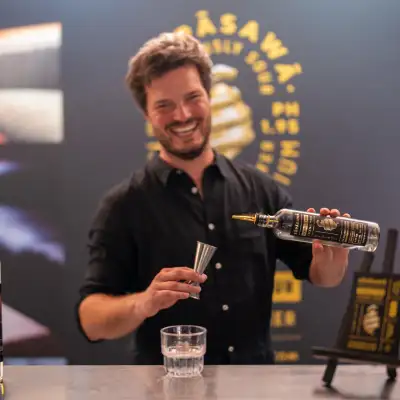
Making a Functional Category Cool | How Guillaume Lambrecht Turned Supasawa into a Lifestyle Brand | 107
Summary
In this episode of MAFFEO DRINKS, Guillaume Lambrecht explains his approach to creating market demand for Supasawa, a shelf-stable sour mixer, focusing primarily on his category creation methodology. We go through how he developed the product through 60-70 recipe iterations and managed customer validation through direct bar visits rather than traditional market research approaches. This episode details his methods for educating customers about operational problems they may not recognize, including face-to-face conversations, hands-on demonstrations, and using customer discovery as cost-effective alternative to extensive market analysis. Guillaume outlines how he leverages direct customer feedback to establish new product categories and build market awareness from zero recognition. Timestamps: 00:00 Introduction: Market Validation for Unknown Categories and Invisible Problems 05:37 Product Development Process: 60-70 Recipe Iterations and Customer Feedback Loops 11:35 Customer Discovery: Face-to-Face Bar Visits and Problem Identification Techniques 19:31 Market Segmentation: Skill-Based Bar Typologies and Operational Complexity Analysis 32:45 Workflow Innovation: Pre-Batching Systems and Extended Shelf-Life Benefits 38:04 Customer Education: Problem-Awareness Creation and Solution Positioning 45:12 Market Creation Strategy: Category Establishment and Demand Generation TacticsThis is Maffeiro Drinks.
Guillaume Lambrecht:The question, in fact, is a little bit, yeah, how do you create demand if if such a product is really not really existing right?
Chris Maffeo:In this episode I'm joined by Guillaume Lambrecht he's the owner at Deluxe Distillery and probably you know him as the the mastermind behind Supa Sawa.
Guillaume Lambrecht:We are not interested in flashy marketing campaigns or or or or vague promises. The face to face conversations with the tastings, with the workshops, with with the, I mean, I would say hands on demonstrations like doing your cocktails yourself.
Chris Maffeo:With Guillaume, we speak about the challenges of creating demand when you actually don't know the category. We we speak about the challenges of creating a product that goes beyond categories. It's, it's almost a non existing category or what I like to call a micro category or a bottom up category. And, you have to create demand for something that does not exist yet. So how do you create demand?
Chris Maffeo:How do you bring people on board? How do you identify that that's an actual need? In this episode, we speak about the importance of building a community and we go through some of the aspects that Guillaume and the team are working with every day, you know, launching the brand different markets but also establishing their presence in bigger and smaller trade fairs. You know, we bumped into each other very often at, at Barcomer Berlin where his stand has now become a destination for, for bartenders. So I think I've said enough.
Chris Maffeo:I don't want to spoil it. Let's dive in. Hi, Guillaume. Welcome to the Maffodrinks podcast.
Guillaume Lambrecht:Hi, Chris. How are doing?
Chris Maffeo:Fine. Thank you. Like, it's a real honor to have you. The reason why I I wanted to have you is because I think you have created a fantastic product and, you know, that I keep on seeing more and more whenever I whenever I travel. So I Amazing.
Chris Maffeo:I want to I want to get something from you and also, you know, like, to share some learnings with the, you know, with the listeners of of the of the podcast so that we can we can all uplift the the industry without sharing too many too many secrets of yours.
Guillaume Lambrecht:Yeah. I will try. I will try. I mean I don't have a lot of secrets with SuperSaua. It's always a fun product to talk about and that's one of our key messages that we try to, I would say, explain everything what we do and what SuperSaua is about.
Guillaume Lambrecht:You almost find the full recipe on our website. That's how transparent we are because we want to help the industry in general. So that's a little bit our modus operantes.
Chris Maffeo:Wow, Fantastic. That's that gives you a lot of, you know, a lot of respect. Let let me let me let me ask you the first question. So tell us about Superstawa in the sense of, you know, how you identify this gap in the market and how how you came up with with this idea?
Guillaume Lambrecht:Well, I would say that that that a super sour so let's let maybe first talk about super sour. So so super sour is a as a shelf stable sour mixer which is really being developed for the professional user in the cocktail scene and the mixing mixology. So it is created to solve a very real and recurring problem in the bar scene and in the whole industry right which is the inefficiency, the inconsistency and the waste problem which we have always with citrus juice right so I think for bars and for restaurants even hotels right I think maintaining consistency and speed are very very important right so I think it's very essential that they have always the same tools at every moment of the day and citrus has always been a wild card right. So it's always been like okay what is going on with the citrus? How old is it?
Guillaume Lambrecht:Do we need to replace it? Is it still okay to use? Because of the oxidation, the change in flavor and also the acidity and also the seasonality. In the winter, in the summer citrus is changing in color and an amount of volume per fruit for example. So as a result bars are wasting time, money and product right because citrus fruits are molding very quickly also so that you have a lot of irregularities in general which makes it a very hard product to work with and we wanted to change that right.
Guillaume Lambrecht:We wanted to change that element of the bar industry so people are struggling less with that element. We wanted to develop a ready to use citrus alternative without being a real complete switch over from citrus in flavor and in taste but just to have the same effect in cocktails without having all the irregularities and the negative sides of the real fruits right so that's the bit the element that we wanted to create. How super sour is really made I would say Chris so at the moment because I told you just before our almost full recipe is on our website right so just to clarify so super sour is like it's made from purified water distilled water where we balanced it out with five carefully chosen acids food graded of course. We added a touch of salt and a minimal amount of sugar to round off a little bit the sharp edges of those those assets because otherwise it could be very very straightforward.
Chris Maffeo:Sour.
Guillaume Lambrecht:Too sour and also maybe too unpleasant to have it in your cocktail. But to be very clear, it's not a sour sweets. It's just really 100% sour. So it's really just round off the the complexity of those assets and each component has been chosen in that way. We made like sixty, seventy recipes around the testing phase.
Guillaume Lambrecht:We used different kind of bartenders to try it out in all kind of ways to see okay what works what doesn't work. Is it balanced enough? Is it too sour? Is it too sweet because of adding too much water for example? All these kind of things and we wanted to have a perfect liquid which is always the same and with the recipe you always have that element right it's always the same it's ready to use just open a bottle start pouring start mixing start doing your own magic And that's the bit the idea of what we we we were trying to create.
Guillaume Lambrecht:Right?
Chris Maffeo:Wow. Wow. And and you mentioned bartenders now. Like, the you know, how how did you validate that this was actually something that bartenders really wanted because, you know, the insights is is fantastic, you know, like on what you rightfully explained. But then, you know, for some people, know, there could still be a not a need.
Chris Maffeo:No? And then they would say, okay, actually, yeah, it would be nice, interesting, but I don't need it now. So how did you find out, you know, how did you validate that they were actually interested in, in the in the product?
Guillaume Lambrecht:It's a topic that I can talk hours about it, Chris, so I don't know how much time you have. But I think the question in fact is a little bit, yeah, how do you create demand if such a product is really not really existing right? So how do you make people aware of the problem that they have without knowing that they have a problem right? So I think it's a little bit the idea of it's not if when you enter a bar you have to pinpoint the pains that a bar and a bartender has right and so it's a massive challenge but also a massive opportunity just because you need to make them aware of that problem so they can save so much time, effort and space. Right?
Guillaume Lambrecht:So, and how did we do that is really to, I call it always, and it's a marketing term, of course, it's human to human. It's really going into the bars one by one myself, my sales managers, just going into like okay how are you doing, how is your cocktail list going on, what is working well, what is not working well And just with this face to face, we really encounter very quickly that they tell their problem themselves, And that they always have problem with their citrus. Oh, oh yeah. Oh, and then they see when you are the, mostly when you are salesperson in the bars, are mostly one of the first coming into the bar, right? Probably also one of the first ordering a cocktail.
Guillaume Lambrecht:And the only thing that you always see with when you are the first one in the bars is like they always smell their citrus or oh, it's still looking good, is it not oxidate, is the color still okay. That's the problem already just they are showing it the problem just in your face right and then you can open a conversation with them without any problem and that's how we are doing that. We are not interested in flashy marketing campaigns or vague promises. Face to face conversations with the tastings, with the workshops, with the I would say hands on demonstrations like doing your cocktails yourself to really say look that's a clear daiquiri that's a daiquiri that you make with your own citrus. How does that differ?
Guillaume Lambrecht:What do you like the best? There is a different kind of conversation there And this is a little bit how we started the conversation and also the demand, right? And it's about earning trust. It's about playing into the game of understanding their needs, I would say and also what the industry is needing for the moment because in some for example Chris I mean Europe citrus lemon and lime we have enough it's coming in daily by boat and everything like that But we have a lot of countries also where there is almost a very big shortage in limited lives. For example, I have beautiful conversation with countries worldwide and we see that there there is a big bigger problem than even in Europe but it's then a different conversation because there it's just to replace really citrus and liminal limes for example where they will think about speed, consistency, about labor costs, about efficiency and all this kind of things.
Guillaume Lambrecht:So it's all really about peer to peer. It's really human to human and it's really having that conversation going. And when you try it out with Supersala one by one they are very quickly motivated to try it out. I want to state also, Chris, that it's not really our ambition to really eliminate citrus or lemon or lime completely from the bars because it has for sure a place, right? So that's something that you really need to understand.
Guillaume Lambrecht:We just want to reduce I would say the usage of liminal limes to the bare minimum because it's the most wasted product behind your bar. And for a bartender maybe not so much except if of course if he is for example the bar owner also. But for bar owners, bar managers, F and B managers, even CFOs right who are making the calculations from everything It's so important to reduce waste so much because we have proof of concept in so many smaller groups for example in Poland, in The US and in Australia where they use super sour and where they instead of okay they buy our product of course but they earn money by using our product because the less of waste, the less of labor costs, all these kind of things. So it really helps. We are offering a solution for a problem that they sometimes in the beginning face didn't know they had, but now they really start to understand that, well, Super Saiwa is really a whole new realm.
Chris Maffeo:There are different kinds of bars, you know, like this. There are the, you know, the more geeky ones that they want to do their own creations and they do all their syrups and all their, cordials and all the things by, by themselves. And then there are more, you know, kind of like high speed bars or places that maybe don't really mind, and then they want to find a solution. Did you did you identify, you know, like, what were your typologies of of bars that you wanted to to have that kind of conversation?
Guillaume Lambrecht:Well, typology, let's put it like this, that our strategy in the beginning, of course, we always want to know the feedback from best mixologists in the market. Right? Because if you like them or you don't like them I really like them so for the people who are listening great. They are so important. Mean they are the top of the world in what they are doing because they have proven themselves of being magicians.
Guillaume Lambrecht:For me the best mythologists in the world are magicians. They are doing things with spirits and with taste, with aromas what nobody else can do and you have to respect their knowledge behind everything. And we know that super sour is maybe not for everybody because we all know that the best bartenders in the world will make their own asset mixes. They are always found on what they make is always better. Will we counter that with saying oh it's cheaper or with that or that?
Guillaume Lambrecht:No we are not the cheapest solution and say we are just a very practical solution when they don't have time, where they have a lack in labor, all this kind of things that where we make the difference. We also have the people for example Chris that where people say I always use only fresh juice right. I don't want to get away from that. And then we need to make the conversation also and we respect every kind of feedback that we receive. But with SuperSour, even if you want to use 100% juice, for example, we always say that okay, it's no problem.
Guillaume Lambrecht:You can always keep on using your fresh juice. But have you even thought to even blend, for example, SuperSour with your fresh juice? For example a fiftyfifty blend or a 70 fivetwenty five and then they always ask me yeah why should I do that? I would say yeah instead of having one liter of fresh juice now you will have two liters of fresh juice without having more work. It's just blending them together and your life cycle will go from two days to four to five to six days.
Guillaume Lambrecht:So in that way it all makes them rethink their whole process like wow for the same amount of juice I have twice the amount of product which extends the life cycle by times two times three. And in that way we always have a conversation with the best buttons like I would say who would I say I don't know. Let's just put it like this, all right. The best buttons in general, they are great and they are very fun on their own makings. What we always do, what we always see is that having a bottle under the counter always helps them out in difficult moments where they didn't expect to have 100 or 150 people coming in at once, where they don't have enough preps, and then they know that they always have something in the backhand.
Guillaume Lambrecht:And that's always the way on on what what Superstar stands for. It's always always ready for you. It's always the same recipe, so you can always rely on it. And that's the bit the message that you want to send out.
Chris Maffeo:That's that's that's great. I mean, I I really like this thinking because sometimes it's also about this kind of like purist approach now that, you know, in theory, you know, we we all we all know, like, you know, like, the theory, the theory is always fine. But then, you know, you always have those days when you need help. And to get that conversation right to the people, I mean, might be people that get it right away and then it's like, wow, this is exactly the solution I wanted to, you know, I was waiting for. And then some others a little bit less, but then, you know, they still get it.
Chris Maffeo:That is like, okay, let let me let me buy a bottle and then let's see, let's see when when I will need it. It's it's one of those things like you you you always think you don't need it until you need it.
Guillaume Lambrecht:200%. 200%. And it's also depending a little bit, Chris, on all the kind of venues where we are at. You know, we are now talking about the best mixologists in in the world, for example. That doesn't need to be necessarily small volume bars because we know that some of the best bars in the world are very large volume bars right, but we have several we can talk about cruise lines, we can talk about hotels, about beach bars, about pop up bars.
Guillaume Lambrecht:Every kind of bars have different needs and the level of bartending is also different and also the knowledge. Can't expect, with all due respect for everybody listening here, but you can't expect that the bartender from a pop up bar, of course if maybe he can be very experienced, I don't know, but in main case it's mainly one bartender who is very experienced and then you have four or five bar backs to help them out a little bit and you can't expect that from that one bartender that he can do all the preps by himself and all this kind of things. He is really in need of solutions and quick wins to make his time and work. It's all about time, all about precision and you want to have that first cocktail of the day and the last cocktail of the day taste the same. And if you have citrus juice it's great but you need to taste every cocktail that goes out right because every citrus fruit is tasting differently.
Guillaume Lambrecht:You have different ph value, it has a different odor or aroma and with Superstar we know that the first margarita which goes out and the last one is going to taste 100% the same and that's about speed about consistency and I think for very large volumes volume bars that's what you want speed and consistency so that you don't get five cocktails or 20 cocktails back from what you send out. That'll come back, oh, it's too sour or it's too sweet. That's something that you don't want as as a venue because you, again, you lose more money on top of that.
Chris Maffeo:We we we we often disregard crucial aspect. You know, I work with segmentations every basically every day, every week at least. And and, you know, I'm I'm developing, like, different kind of approaches. And and one of the things that people don't think about is is the level of skill set of the bar that you mentioned, the level of ingredients availability. You know?
Chris Maffeo:Like this, in the segmentation, we never think you know, we always think like pubs, bars, restaurants, high end, Italian restaurants, and and so on. But, ultimately it's about, you know, who's making the cocktail because if you go to a normal restaurant, it's the waiter probably that is going to make the cocktail. If you go to a small bistro is the guy or the girl making cappuccino in the morning that is going to make a gin and tonic. And then may, you know, the enlarging that, you know, choice will depend on ingredients that they want or don't do not want to buy, you know, like when, where there is a is a is a garnish or, you know, like, do they have mint? You know, do they have oranges?
Chris Maffeo:Do they have lemons? Do they have, cucumber? You know, I I, you know, I work with, with, Hendrix, you know, as a genius. It's always like, okay. But, you know, will they buy that?
Chris Maffeo:That was the initial issue of launching Hendrix with a gin and tonic is like, do these guys have, cucumber? You know, because it's not something automatic that you would have behind the bar in a in a bistro. No? So what I like about this is the fact that, you know, you put everything to a minimum common denominator and say, okay, actually you can dare to do certain cocktails that you would have never thought you could do because I'm making it easier from a logistic perspective, from a purchasing perspective, from, you know, many different aspects and also from a stability cocktail perspective because then, you know, if we have prepared it in a in in the right way, then even maybe like a less skilled bartender can dare to make certain cocktails that he would only dream about.
Guillaume Lambrecht:Exactly. No, no. I 300% agree with you, Chris. I mean, it's, every conversation is different with every, every bar, every hotel, every cruise line, every, pub on the corner. I mean, it has a different problem.
Guillaume Lambrecht:They have different skill sets and that's the thing what we are doing with Supersaw is creating a kind of form I would say but a kind of a help solution like we are coming in we are trying to visit all our clients as much as we can. Is it now myself in Belgium or my sales manager in The Benelux or distributors worldwide? We always try to hammer on the distributors like try to visit every account that we have with SuperSal, Try to hand them over the skill set of super sour. Try to explain them what it can do to them and give them recipes because we have a book of thousands and thousands and thousands of recipes of super sour, just very easy cocktails, still even milk washes and cordials and all the kind of things. You have a kind of a skill set like, oh, that's a pup on the corner, they just need two or three easy cocktails.
Guillaume Lambrecht:We will learn them the batching principle right for us as being in the industry batching principle is quite easy right it's all putting together make sure it's stable and then it's just pouring over ice and for a pup that's super easy super fast and super profitable right. For then a more advanced four star five star hotel for example where the bartender is a little bit more advanced already you can do other stuff you explain them about tia daiquiris, tia margaritas, even slushie machines for example. So it's all about showing them the power of Supersawa with their needs, with skill sets that they have and that is really just what we are trying to do on social media all these kind of things. Have two things of marketing that we do right Chris. We are doing some social media and we are doing some presence at fairs and to be honest that's our only thing that we do because we are a small company.
Guillaume Lambrecht:We are only five people in the company so we have a lot of things to do. Our social media we have seen that it's so effective. We almost don't sponsor. Why? Because we want to really create a real community with following SuperSawa.
Guillaume Lambrecht:We are trying of course to work with some influential people and influential people from the bar scene to broaden up our brand to make it a little bit more noticeable but I think yeah that's the way it goes today right you are in the modern world but besides that it's just talking to people communicating with them people asking it's almost my second inbox you know I get hundreds of emails a day for a week for example I get I think almost the same amount of emails end mails by Instagram by people where can I buy it, how can I use it, what is the cost, I have this problem, how can I resolve it? I love that. I mean that's what it's about. That's why people are coming back to us. It's like and almost I say almost everybody who is following us I always send personally to be honest also a small text like thank you for following us if you have any questions or we can help you let me know and I would say 4050% of that is answering with just a heart or a light or whatever or some people are just already immediately answering oh I have this problem can you help me or do you a recipe for that or whatever So it's great that people are coming back to us with questions, and that's the community that we are trying to build.
Chris Maffeo:Nice. Nice. Nice. And let me let let's take a step back for, for this one because, I mean, you mentioned, like first of all, like, to clarify for, you know, not too heavy to technical, like, you know, you mentioned better, you know, pre batching now before on on so just so that the listeners, you know, know what we're talking about. So can can you just articulate a little bit better, like, what, how you help this pre batching and what pre batching is in these terms?
Guillaume Lambrecht:So the batching principle or the pre batch principle is in fact a very simple way of making cocktails. So we have all the components. Some cocktails mostly consist about three four ingredients. We have the sour part, have the sweet part, we have the alcohol and then we have maybe an added flavor or a second alcohol for example for simple cocktails. Let's put it like this.
Guillaume Lambrecht:Batching is in fact preparing the cocktail at once in advance I would say. So before opening for example you make the cocktail you put it in bottles of whatever bottles that you want to use and the problem is with with batching if you don't use super sour for example after a couple of days it goes bad because again citrus is very volatile it's very ineffective and unstable. After two three days the oxidation process started and to then do pre batched cocktails with this kind of fresh juices it's a little bit tricky, right, because you don't know whether you have five clients today, whether you have 20 clients today, whether you have 100 clients today. So you never know how much batching of cocktails you need to make upfront. So with super sour, the fun thing is that because of the high sourness, the high pH of 1.95, when you batch all the components together in bottles, so you have 10 liters of, for example, a gamete for example, right?
Guillaume Lambrecht:You put the three ingredients together, the sugar, the super sour, and the gin for example. You put everything together. With that being ready, you can make a cocktail. Just take a tumbler, put ice cubes in it, put the pre batch cocktail into the glass and you can garnish it because you have time now to make a beautiful garnish and then you can serve it. It will look as professional, as good as before.
Guillaume Lambrecht:And the thing is you can now batch with Super Sour for two, three, four, five weeks in a row in one I would say it's time moment, right? In one moment. Whereas with real juices you needed to batch almost every day or every two, three days at the max or at the minimal. Now with SuperSour you save a lot of time with just the batching principle and that's what's helping a lot of people and a lot of I would say even high volume bots even from a high level because it's a trend also a little bit right now that people are indeed seeing the benefits of batching. Even the best buds in the world are doing it.
Guillaume Lambrecht:That's a bit the idea what we are trying to sell them to be more efficient and to not think about oh no I need to get up two hours more because I need to batch this, this and this and this. Oh no, fuck, I forgot. I have already done it two weeks ago. I still have a couple of liters. I'm okay.
Guillaume Lambrecht:I can sleep two hours more or I can go to the gym or I can spend two hours more with my family. That's the whole thing that we are trying to give them, back. You know?
Chris Maffeo:That's all for today. I hope you enjoyed this episode with, Guillaume Lambrecht from Supa Sour and the Deluxe Distillery. We went through many, many things, building a category, building establishing a category that is not known yet, how to identify, a need, and to check that that need is actually really a need by bars and bartenders. And we also speak about, you know, how to build demand, how to sustain the demand, how to work with trade fairs. There's a lot of information.
Chris Maffeo:And if you want to get a deep dive from the episode with a detailed analysis, you can get it and subscribe at mafayodrinks.com. If you can think of a couple of people that you think would benefit from listening and watching this episode, please share it with them, available on video, in Spotify, in YouTube, and in audio in all the other platforms like Apple Podcasts. That's all for today, and remember that brands are built bottom up.
Creators and Guests