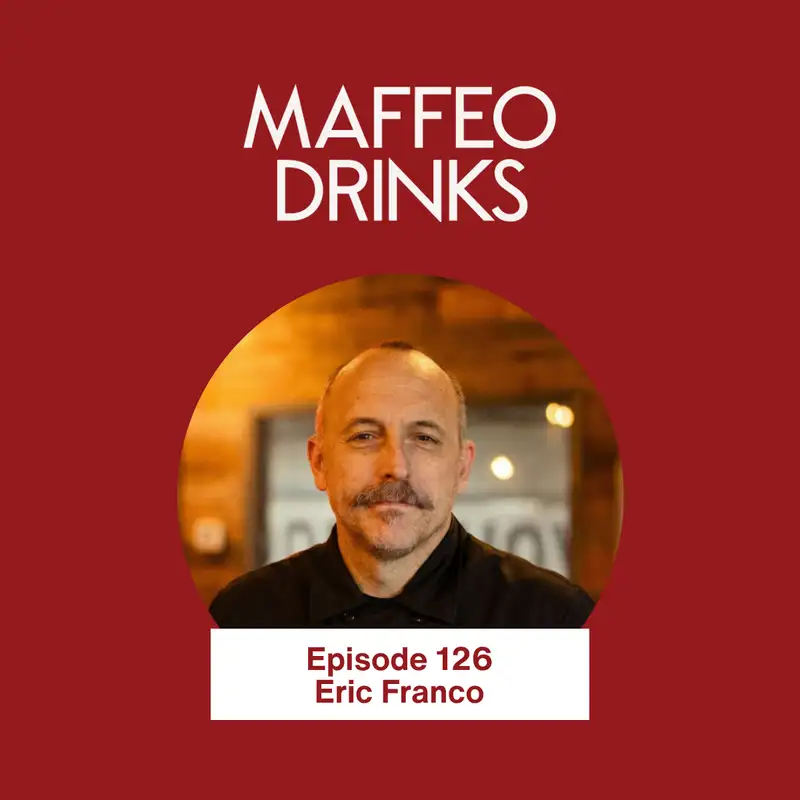
126 | The US Market Obsession: Distribution Complexity, Craft Beer Lessons and Heritage Versus Exit with Eric Franco
Chris, how are you?
Chris Maffeo:I'm fine. Thank you. What about you?
Eric Franco:I'm well, man. It's been it's been a little while.
Chris Maffeo:So let's start. You know, you're based in The US. US plays very often that role, you know, whether from a European perspective, from Australian perspect you know, from any brand that is not US specific, is not born in The USA, so to say, wants to be in The USA. And there is this I call it, like, The US market obsession. You know?
Chris Maffeo:People have to tick the box, tell their shareholders, their stakeholders that they are sold in The US. And, you know, my LinkedIn is full of, you know, finally available in The US. You know? And I'm I'm always looking at those announcement, and I'm like, shit. So what's your experience with that?
Eric Franco:Well, it's the most profitable beverage market in the world. Right? And so the complexities of The US market, I think, for a lot of people go unchecked until they arrive here and their brand arrives on the dock in Jersey or in California or wherever it's coming from, it's very complex. And every market's complex and has its own complexities. The three tier system here clearly is a different type of system that requires additional thinking and planning and prepping depending the type of brand.
Eric Franco:Right? If if we're talking alcohol specific, very, very complex. And it requires so much capital, Chris, that I don't think people realize if they have this idea that they're gonna conquer the entirety of the country and have countrywide every state distribution. The amount of capital it takes to do that, the amount of people it takes to do that is daunting. And not to say it can't be done.
Eric Franco:There's really good examples of that. You know, my experience has been that I've worked for big domestic or global brands that have that footprint, that churn through even when you and I met on SAB when SAB acquired or bought Middle Brewing Company. I think they would tell you and in talking to people that were part of that generation that the these that that SAB came and while it it became successful, the complexity, they they couldn't have planned for it specific to The US. Right? Very big business and evaluation.
Eric Franco:Absolutely. But the complexities of of what they found, I think, stunned them and made them rekind of identify how they needed The US to be part of their global equation. For smaller brands that wanna go wide, too wide, it it it could bury you quickly. But you mentioned New York. Incredible beverage city.
Eric Franco:Right? So many bars, so many hotels and restaurants, so many mom and pop bodegas and whatnot. You can have six people in New York. You and I could start a brand tomorrow, a a spritz company. Right?
Eric Franco:And you could import or a Czech lager company, and we could have New York we we would need 10 people in New York City, and it would take us years to crack the code of distribution and feature and promotion and the rhythm of the city. Just the one city. That's not the rest of the state. Right? So I think it all depends on what you want your brand to represent and then being patient with how to get there because it takes a lot of steps as you know, and you talk to a lot of large brand owners and brand holders, and I've worked on those brands as well.
Eric Franco:It's a daunting task, but I always say just don't put too much pressure on a brand early on because unless you are super capitalized, things could turn quickly.
Chris Maffeo:Absolutely. And I mean, like, when I left
Eric Franco:the
Chris Maffeo:CB after the Assahi bit, I went to Carlsberg. And in Carlsberg, I was in charge of the operation that were called big cities because actually it was like this. You know? There were small operations in each city. It was the same amount of people that we had in Sweden when I was on working on S.
Chris Maffeo:E. B. Miller as an export market. It was just, let's say, Philly. Yep.
Chris Maffeo:You know? Yep. Or the I mean, not talking about Mexico City, not talking about Santiago De Chile. They were basically microstates, you know, as a city. You know?
Chris Maffeo:So, I mean, US itself is a huge market. It's like, I'm gonna launch in Europe. You know? You can't launch in Europe. There's no such thing.
Chris Maffeo:I mean, there's the European Union, but there's no such thing as Europe as basically there's no such thing as The US because there's, you know, all the states. So often, I mean, you and I talk about football a lot. The the it it's almost like you like to play football even if your dad, you know, owns Chelsea or Arsenal and they sneak you in the first, you know, the first team. Yep. Are you sure you don't wanna have one of the first matches in Premier League or in Serie A, you know, when you are learning how to play football just because you can, just because your dad has put you there?
Chris Maffeo:You know? Or is it better to play in the you know, in back in Italy, we had the church backyard, you know, when you go and and
Eric Franco:I played in those leagues.
Chris Maffeo:Not in Italy, but I played in those leagues. Just because you have an opportunity, it doesn't mean you should grab that opportunity. If you say no to that opportunity in the right way, it's like, listen. I'm aware of the huge opportunity you're giving me, but I don't feel I'm ready for that. And, you know, let's talk again in one, two, five, ten years time.
Chris Maffeo:I I'm aware of the fact that that train may have gone, but I don't wanna jump under the train either.
Eric Franco:Yeah. Look. The US is an incredible beverage market. Right? It's incredible.
Eric Franco:And it does allow you, when you do it right, to have access to a lot of different kind of consumers and occasions. You can build a lot of valuation. Ultimately, it's a business. Right, Chris? And so you wanna build equity of your brand, and The US does allow you to do that.
Eric Franco:It does expand past the shores. If you're coming from Asia or you're coming from Europe, there is credibility of being in The US market. And there's a significant potential evaluation and driving heavy valuation because of the way it's set up and because of the amount of outlets and what that looks like, specifically in chain. I think what the difference is is that the model is very different. I was in Asia a few months ago.
Eric Franco:And even when you go to Europe, the drinking culture is different. How people react to brands is different, how they utilize brands. I think the entree is an example. You and I have had many conversations on the entree globally versus The US. The pub culture, which has declined for years, but that was always a place to go together.
Eric Franco:It's a community kind of hotspot. Bars in The US don't necessarily have that. Right? Most people go and they'll buy at a Walmart or at a Kroger or here in Michigan at a Meijer. Right?
Eric Franco:They'll buy at a Total Wine and More. It's very chain driven, similar to what you do on premise here. You know? Go to Dallas or Houston or any major city in The US and casual dining restaurants and chain restaurants dominate. That's just kind of the American way.
Eric Franco:And so if you have the ability to go and talk to a Buffalo Wild Wings about your brand and then you can gain mandates across the country with one touch point, people view that as kind of the holy grail of, you know what? I've got an opportunity, and I can really scale quickly to do that. It's harder to go door to door. And you know this. I know this.
Eric Franco:You live in a city that and you do this for a living. You go door to door, you investigate what each of those occasions and each of those outlets mean. I think it goes back to what your brand represents and what you want your brand to be. I think a lot of people have this idea that they can build a brand, have a really good idea, which a lot of people do, and that they wanna be acquired. I've talked to people over the last month.
Eric Franco:So many people have an idea, but they want that idea to be a three to five year plan, and then they wanna be acquired or they wanna sell it. That's kind of the new model. Right? I think the days of saying, hey. You know what?
Eric Franco:I've owned a I started a brewery in my backyard and started home brewing. And twenty years later, I I have a pretty successful business. I don't know if people really wanna put twenty years into hitting the streets and going through the complexities of owning a brand and the regulation and the marketing and the taxing and all the things that go along with it. Tough. That's true.
Chris Maffeo:It's difficult. We tend to forget the fact that many of the old brands that we see now, they were family operations. I always go back to my great grandfather grandfather story of their wholesalers that they had. It was over one hundred years. It was feeding many, many mouths.
Chris Maffeo:Nobody has ever thought about, you know, we'll we'll exit. Well, that was the way of living. You know? That was your job forever. You had that kind of generational element.
Chris Maffeo:It's like, I do the right things because my son and my daughter, hopefully, they'll do their own right thing, and they will leave it to the next generation and will be known in the city for that. You know? And I still when I go back to my family old town, although I've never lived there, I only went there to visit my grandparents when I was a child. I mean, once I was stopped by an old man on the square and he said, you're the grandson of Don Vito. Yet I never seen the guy before.
Chris Maffeo:He never seen me. He just looked alike my my grandfather. You know? And he was like, yeah. Yeah.
Chris Maffeo:Great, great man. And he just walked by and left. You know? So it goes back to the trust and this element that we are discussing that is very important to say, don't jeopardize your future when you are building something, whatever the pace is.
Eric Franco:Chris, and it's interesting you say that when you talk about heritage, you talk about that hundred years. You talked about that really great moment on the square, right, where there was validation of of the equity that your family built over generations. Even in the craft industry, we talked about beer here in The US. If you think about the biggest, most heritage craft brands, let's call it Boston Beer or Sierra Nevada. Jim Cook worked that brand for decades before it was successful.
Eric Franco:I happened to be selling that when I opened my bar back in '94. The brand was fairly young at that point, but it was ten years plus old at that point, roughly, probably. So if you think about Boston Beer, that's not an overnight success. If you think about Sierra Nevada, you think about the the Michigan big Michigan breweries here that I one of them I work for, you know, those guys put in a lot of time, a lot of toil, a lot of struggle to get to a particular size and a particular valuation. I think a lot of what's happened now too is there's a saturation of brands in The US for sure, and I'm sure across the world.
Eric Franco:But in The US, there's such a saturation of brands that it's so difficult to get ahead. And the brands that are seeing real success are those new brands. You think about athletic as a good example. Right? Really smart guys had a great idea, had a a passion for, and had a realistic story because he didn't wanna drink alcohol anymore, but he loved beer.
Eric Franco:So he created this thing that it's not like Coors and Bud and others Beck's and others didn't have non alcohol beer. Non alcohol beer has been exist in existence for since the eighties. Right? Seventies maybe? But he had an idea, which was novel, which became something quite unique.
Eric Franco:Now you look at this insanity of of all these new brands. Innovative brands and thinking, I think, take you to the next level. Adding another lager to the marketplace, adding another IPA to the marketplace, I think it's gonna be really difficult for new brands to get into probably anywhere in Mexico. If you and I decided we wanted to start a tequila brand in Mexico and we launched a new tequila in Mexico, the odds are it's not gonna be super successful because there's so many brands. But if we started a brand that was a hybrid tequila that was flavored or whatever it was, that was very innovative, there would be a better chance because we've evolved the category.
Eric Franco:We've thought through solutions that the consumers and retailers are looking for. And I think that's the other thing about The US, Chris, that more people think about the consumer in The US when realistically, you also have to really consider your brand as a solution to the retailer. Because if you go to Kroger or Walmart, they want your brand to succeed by generating revenue. And the only way the consumer's gonna see your brand at a Walmart is if it's on the shelf because the consumer will go there and shop. And if your brand's not on the shelf and another beer is or another spirit is, guess what they're gonna do?
Eric Franco:They're gonna convert. They're gonna buy something. They're not gonna go and drive forty more minutes to go find your bottle at a bottle shop.
Chris Maffeo:100%. So let's stay on beer. What do you think that can be a learning for other categories?
Eric Franco:Well, I think there's an understanding. I think the consistency, especially the larger companies and the successful companies, whether it's domestic or craft, I think there's been a consistency in how the consumer sees your brand. Right? When you go into grocery here, you go into liquor, beer typically has been a lead category for retailers for many years. So I think beer and the industry has done a really good job of connecting their brands and let's call it I know people don't like the word liquid, but the liquid to occasions.
Eric Franco:So I think beer's done a great job of being associated with sports, right, and canned beer in particular. Right? The sporting event people typically associate sporting events with beer. Spirits have done a nice job of kind of getting into that, but beer predominantly is the beverage of choice when you go to a sporting event or a tailgate as an example. So I think beer has done a really good job of tying occasions to their brands and to the category in general.
Chris Maffeo:I think there's another element that I didn't think about it, like, for many years until I worked for spirits brands. I realized that beer was the reason why I was obsessed with rotation. Beer expires. Spirits don't. So when the the the first thing that kind of like hit me when I started working with spirits brands was that the sales team was very much focusing on distribution rather than rotation.
Chris Maffeo:While in my past, especially when I was working for Pilsner Urquel, which is kinda like a delicate beer. You know? You have to once you open the keg, you know, you want to get rid of that keg within three days. I mean, you had your own bar. Opening a keg is a moment of like, now I need to sell this out.
Chris Maffeo:I don't want to waste my time, you know, on other elements. For me, that is a kind of like that's proper mindset even as a consumer. Whenever I enter a bar, I scroll around, you know, whatever people are drinking because here there's usually the the glass is matching the liquid. And I'm like, I may not go for my favorite beer. I may go for the beer that I can see is rotating the better because I know that that means it's fresh.
Chris Maffeo:That means it's a
Eric Franco:good beer. Yeah. You bring a good point too. Right? As I think there's the breweries have the ability to really market their brands differently in the entree.
Eric Franco:And when I say by that is to your point, you have an incredible, you know, and Pilsner quail still is my favorite beer of all time. So but you have an incredible pour, and you have that glassware. You have branded glassware. You have that you're able to create that affinity in that moment of, in that case, premium and really talking about all the things that you would with a Pilsner quail. You know, in The US, if you're at a sports bar and you want a pitcher, you can do 60 ounces of cold, whatever cold lager you wanna pour as well.
Eric Franco:Right? It's different if for a lot of spirits, Jaeger, you know, is probably different because it's synonymous with shots and having the cold machine behind the bar. So there's the ability to do that. I think beer is about turns, but it also gives you the flexibility to be able to do a lot of different things with it. I always looked at beer for me as kind of the baseline for my business.
Eric Franco:I was I had I also had cocktails, but I also always wanted to make sure that I was able to kind of offer and drive that occasion for people that start with a beer, end with a beer. Maybe their beer all night. At some point, someone's gonna drink a beer. At some point, not everyone's gonna order a really great cocktail or shots. So I think there's more occasions for beer, and I think at the end of the day, we've lost our way a little bit in beer, though.
Eric Franco:I think it's not as not as fun as it once was. I think people don't talk about it the same. Clearly, are drinking and consuming differently, but I think beer kind of got too complex. I I tell the story, Chris, a lot about like, if you think back in wine in the nineties, early two thousands when, you know, you had kind of there wasn't permission to go into wine really easily. Right?
Eric Franco:Wine spectator, if if you were drinking you and I were sitting down and drinking something that was an 89 and wine spectator, people would look at you kinda like, oh. Or if you wanted a red wine with fish, people would scoff at you because, well, you don't do that. And then they've quickly figured out that they probably inelinated a lot of consumer base. And now what do you look at wines and boxes, wines and cans, wines and Tetra Pak, wines and every kind of conceivable vessel. Right?
Eric Franco:And people are now more willing to talk about wine and consume wine because it's more accessible. Beer, I think, has gotten too complex, especially in The US with craft. Too many brands, too many skews, too many we got too fancy with it. I think simplified and going back to your point of being something that is accessible and and that can turn.
Chris Maffeo:You mentioned craft on the beer side of things. And earlier on, you mentioned something about the different kind of consumers, now different kind of taste profiles, like, you know, the Midwestern versus the IPAs. How does taste and occasion change across The states?
Eric Franco:Yeah. And I think when you look at, like, geographies like the Midwest or let's say the Great Lakes where I'm in currently, sometimes you're gonna get a little bit of a boulder profile. Right? You're gonna get a little more of a hearty profile depending on the time of year. And it's probably not different than if you go to Nordic countries.
Eric Franco:They probably consume differently, and their profiles are different than maybe where you're from originally, where some of those are maybe just different from a taste perspective. I think what you get is especially in craft, but even in spirits, I think on the coasts, you get you probably have a little more willingness to be innovative and to try kind of I don't wanna say niche flavors, but I think because the coasts are exposed to a little more, you know, West Coast from Asia, East Coast from Europe, and all the things that go on there, I think there's a little more willingness to explore niche and kind of unique flavor profiles. And I think you'll see that in beverage and beer specifically, but also even in food and whatnot. The closer you get into the the heart of the country in the Midwest, maybe less willing to do that, but more kind of traditional styles styles that made their own. Midwest IPAs are a thing as an example versus West Coast, right, which is more kinda taking that heritage old school Pac Northwest hop.
Eric Franco:Right? Super piney. They've added more malt here in the Midwest as an example. Right? So it's a little more balanced.
Eric Franco:So you have a little more malt character to it. And, again, I think that's part of the climate and part of kind of the ability to wanna, you know, drink your beer with food as an example. Right? They're probably a little more balanced for that. More blended and balanced as you get more central, maybe less spicy as well.
Eric Franco:You think about where I'm from originally in Texas. Right? There's gonna be more spice to everything. The beers probably and the alcohol probably in general might take some of that. Right?
Eric Franco:Whether it's in cocktail form or in bottle form or in beer form, you're gonna have more willingness to kind of celebrate. And when I say spice, not Chile necessarily hot spice, but just in general, just kind of spicy kind of blends or formulations. Mhmm. Obviously, you go to Florida, you're gonna have a really, really heavy influence on from The Caribbean and from South America. Right?
Eric Franco:So you're gonna have some of that nuance in terms of the beer and the types of styles that they produce. You're gonna get a lot more lagers there. Right? And the IPs they create are gonna be a little more prone to having that kind of influence as well. So I I think there's a lot of that goes on, and that's why it makes it complex too.
Eric Franco:And that's why, Chris, when you have a Midwest IPA and you try to go way west with it, it's difficult because it doesn't always translate, especially depending on your branding. If you take a a Michigan IPA and you go to California, people in California don't there's no resonance with that. Mhmm. So it's very difficult to then educate the consumer in retail why they should take an IPA from Michigan when they've got 60 breweries within 50 miles of their retail headquarters. Yeah.
Eric Franco:Very complex.
Chris Maffeo:And we go back to what we were discussing before about the proliferation of brands, and then all of a sudden, it's just like being known for something because it's tough out there. You cannot just go and think you're gonna conquer x y z country or city or state just because you have a fantastic product. There's so many fantastic product.
Eric Franco:Well, I think the other thing too, Chris, is that's why you're seeing companies and breweries becoming more beverage companies. Right? You think about Boston Beer. Right? I mean, a lot of what they sell now is not beer because that translates a lot easier state to state, coast to coast.
Eric Franco:If I create a blueberry or a raspberry seltzer, right, that's not unique to the Midwest or New York or Florida. That translates everywhere. So it's easier to sell, and the consumer base is a little bit wider. Right? So it's really interesting to see the dynamic and the shift.
Eric Franco:Non alk is an example. You know, non alk lager. Well, that that probably plays everywhere. Right? It's easier to market that than it is a very nuanced specific kind of IP or product as an example.
Eric Franco:Right? Like, if I'm creating a porter that's made with Midwest malts and Michigan hops, I'm not sure people outside of Michigan or the Great Lakes are gonna have a real interest in knowing about that necessarily. And if they do, it's gonna cost me a lot of money and time to be able to do that.
Chris Maffeo:And and why do you think the you know, going back to beer, I mean, you've been in big companies and smaller one. Like, why do you think that the craft beer movement, you know, has taken on The US so so well. Why I mean, that was basically what what started the overall craft movement.
Eric Franco:Yeah. And I was fortunate, Chris, to like I said, when I opened my first place, it was '94. And, you know, it was kind of at the first iteration of what back then, it wasn't called craft. It was called microbreweries. Right?
Eric Franco:So I think people just wanted new profiles. I think people were interested in beer at the time, and there were so few options at that time. You had the big three, really, and they were separate. They didn't it was Budweiser, Miller, and Coors. And even Coors, couldn't get past, you know, even, like, East Of The Mississippi River.
Eric Franco:It was very much regionalized. Bud and Miller were national brands, and then you had big regional brands that still had their footprint. But I think the consumer, like a lot of other generations, you don't wanna drink what your dad drank or you don't want a consumer or wear what your dad wore. It it's just an evolution of of people's, I think, profiling and profiles. I think people had lost their way from prohibition.
Eric Franco:And post prohibition, there had been kind of this movement of just getting back into brewing and offering consumers alcohol. Right? And there was that period. And if you think about when prohibition was in The US to the eighties, wasn't that long. And so it it took time to to kind of get people back into a legalized versioning of what breweries would represent.
Eric Franco:I think it got to the point where people just wanted more and different things. Technologies kinda came to brew. People and The US has a obviously, as you know, has a really rich brewing history and tradition just from all the immigrants that came in and and brought their brewing knowledge and prowess with them. And that started again, and I think that's what it was kind of history repeating itself, and then it just caught fire. You know, the February, there was a dip.
Eric Franco:If you think about those big brands, like Pete's Wicked Ale was a brand that you might not be familiar with, but, you know, Pete's was a really big brand. Massive. Fell off. Right? So a lot of brands fell off, and then the ones that had and I think to your point on the initial discussion here, building brands bottom up.
Eric Franco:I think the companies that did that really, really well in the late eighties and nineties survived, and then they had new people come in. Right? And it got inspired by those beers and the beers that their dads didn't drink, and then it just continued and continued. And then now with the technology we have and with formal education, you can go to school to be a brewer. Right?
Eric Franco:There's universities all over The United States and I'm sure the world that offer brewing science courses and diplomas. So now it's not just kind of craft beer in a bathtub or in home brewing. It's a profession. Yeah. It's it's it's incredible, you know, when you talk about on the beer side.
Eric Franco:I think a lot of it too is is the styles. If you talk about the Nordic countries, you think about where you're from, predominantly lager countries, traditionally, Spain, traditional. Not a huge craft movement even today. Now there's craft, yes, and craft does okay. In comparison, if you think about, like and and maybe those craft company and maybe those countries are are actually know, you I know Italy has had a resurgence in craft.
Eric Franco:Spain, you've seen some of that go on, obviously. But you go to Belgium, you go to Germany as an example, which have really rich traditions of not only brewing lagers, but but having very, very specific and and almost a a a really passion and love for brewing. Craft breweries in those countries aren't super popular even today. I mean, I I was in Belgium about a month ago, and, yes, you find them, but people are are still drinking those incredible beers that are produced. You go to Germany and right?
Eric Franco:Maybe it's because of the laws and the purity laws and all the other things that
Chris Maffeo:I see myself here with, you know, in Prague, for example. There are craft breweries, and first of all, they are very much involved also with, for example, with Pilsner Urukow or with Budvar because those brands are still respected brands even by the craft scene. And when you take the, you know, Czech people, like, they may go for craft beer, but then they all go and default back to Pizzo Norco because that is the mother ship. You know? Then you can go for a regatta elsewhere with another beer, but, you know, the mother ship is that, you know, if I have a pub that is doing a proper Pizzo in Urqo, I'll stick to it, and I'm totally, totally fine with it.
Eric Franco:But in some respect, that's that's bottom up too. Right? It's the baseline that you go back to of what is foundationally your set of considerations and the brands that you love and that you drink. I'm the same way. I think in The US, it's opposite in the fact that many craft companies kinda have been it traditionally scoffed at the big companies.
Eric Franco:Right? There was kind of us versus the big companies.
Chris Maffeo:Exactly.
Eric Franco:Right? And so it created this really interesting dynamic. And a big company's always had craft products. They were crafted. Right?
Eric Franco:They were small. Blue Moon is a good example of one that many people would argue isn't craft but is craft. And, I mean, lining Google's as company, obviously, I represented. And when you talk to the spirit side, I mean, there's incredible spirits here, small batch, small companies doing some incredible things. And I think they're earlier and I think they've learned some really good lessons that maybe craft brewers missed on.
Eric Franco:And I think that's where when you think about going too far past your boundary or going too far beyond what maybe is the reality for your brand, I think a lot of craft distilleries and brands here in The US have made a really good intentional movement to own kind of their geography and then slowly build out past that. So it's interesting to see.
Chris Maffeo:My feeling is that when you're not in the eye of the tornado, you know, it's easier to navigate things because the first craft players, I mean, you mentioned before, whether beer or spirits, they did it out of their passion. Obviously, they wanted to make a living, but they never really thought of, like, selling out because they were it was a genuine passion about let's do something for ourselves but for the world as well. You know? I want to get out there a better liquid for my friends, family, and other consumers of of my country. You know?
Chris Maffeo:So then it started to be become more like, okay. I've seen that you are successful. I've seen that that is successful. And then all of a sudden, it becomes like, oh, maybe there's money to be made there. So let's start.
Chris Maffeo:And then, you know, we go back to square one of the shareholders, stakeholders, investors navigating the top down expectations and the bottom up reality, and that's where you start. So let's wrap this up. What are the final thoughts about this? You know, we touched so many different aspects. What are your final thoughts, and how can people find you and get in touch with you if they want?
Eric Franco:No. I appreciate that, Chris. I think, one, congratulations to you. I think talking about the industry and talking about foundational elements of what makes this industry great through your philosophy and through your experience and and sharing that, I think, is great. So congratulations to you, man.
Eric Franco:I'm I'm proud to to call you an amigo and and having worked with you and for the opportunity today. I think for me, I'm always on LinkedIn. I'm really excited to help kind of young entrepreneurs and people getting in an industry, whether it's on the beer or the just adult beverage in general. I think at my stage of my career, it's about helping people kind of move forward on their brands and how to build their brands to to success. And I go back to being a young entrepreneur and those people that helped mentored me and helped kind of guide me along the way.
Eric Franco:It's something that I'm really passionate about of paying back now and really giving back to organizations and people who are wanting to be in this industry and wanting to create brands of interest and of consideration. And so LinkedIn is the best place to find me and super excited to be in the industry still today and loving it.
Chris Maffeo:Fantastic. So thanks a lot, Eric, muchas gracias. And hopefully, we we meet soon for for a beer. We can zebra stripe between a a beer and a cocktail, I guess.
Eric Franco:I'm good with that. I'm in desperate need to go into the caves in Pelzon and have an unfiltered Pelzon recall with you soon.
Chris Maffeo:I'll get that sort if you come over. Fantastic, man. Happy holidays. Fabulous.
Creators and Guests