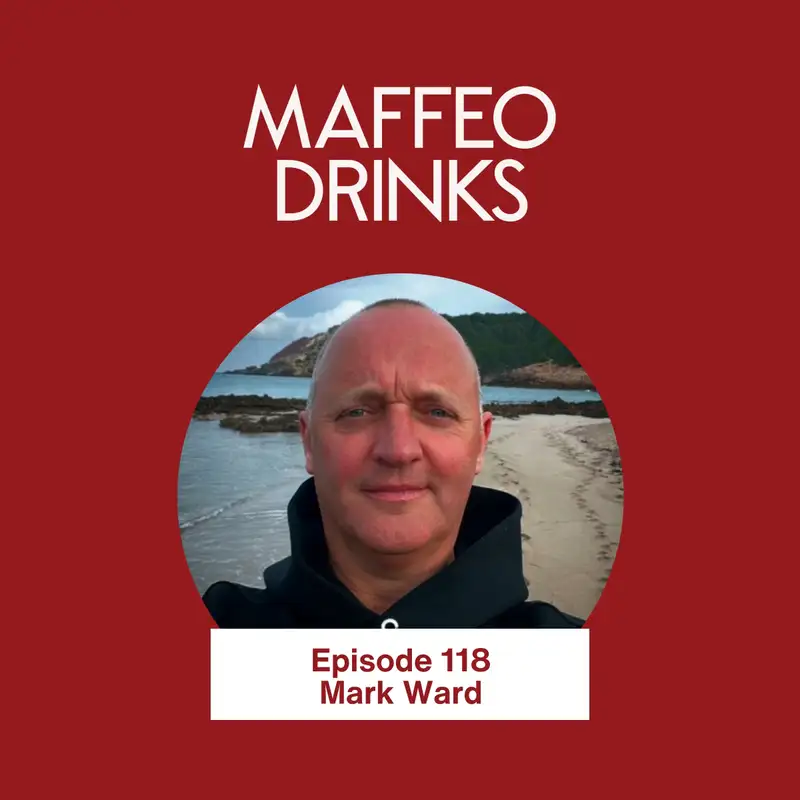
118 | What Bottom-Up Actually Means: Mark Ward, Founder of Regal Rogue on the Behaviour Between One and Ten
Welcome to MAFFEO DRINKS.
Mark Ward:Thank you. Thank you for finally having me on here. How exciting. Definitely, there's a lot of LinkedIn flirting going on.
Chris Maffeo:Until finally we cracked it, and we had a good session because we didn't know each other. Although we know many people in common, but, finally, I look forward to meet you in person. I feel a little bit jealous because I'm a little bit pale compared to you in this recording.
Mark Ward:But Well, you know, I see. I've just a little bum this morning to get ready for this. I need to come into it ready. There's probably more blood pressure than there is anything else.
Chris Maffeo:The tanned Brit and the pale Italian. This is the Fun. It's a good mix. So we had a a chat a couple months ago, and we were talking about the the bottom up mentality. And we realized that there are some misunderstandings about it.
Chris Maffeo:You know? Everybody has a different perception of what brands are built bottom up when I talk about it actually means. So what Yeah. How would you Yeah. Describe what what building bottom up means?
Mark Ward:Oh god. I mean, I've been in this industry now. I actually reflected yesterday and realized it's twenty six years from when I walked into Roger Moore's bar in Mesa in London and said I'm gonna work here with no professional bar experience to having Regal Rogue now for fourteen years. Look, my views are my views, But I think bottom up for me is how you kind of turn one into ten, ten into a 100, a 100 into a a thousand and that might mean bottles, it might mean our five litre bibs, it might mean venues, it might mean retailers, it's just there's always building an alcohol brand is one of the hardest things you'll ever do, or even a beverage brand, and I'm sure the same applies for food brands as well, and maybe even clothes brands, but they're not normal businesses when you involve all that manufacturing and working capital, double it up with how you promote it to increase depletions whilst trying to run a normal business in the middle of that. So they're generally very hard business models, but bottom up for me is just that.
Mark Ward:It's getting out there and trying to understand how you turn one into 10, and what it involves when you get past two, and what the behavior in between, the engagement, the nurturing of the relationship, and then, you know, how that evolves. It's the behavior in the middle, you know, of you get your one, but then what happens? Your one becomes 10, but what are you doing from the two to 10? Then there's a dynamic in the business where 10 becomes 100, but you're only in the two to 10 venues, or focusing on the two to tenth bib, or the second to tenth customer on bulk liquid. It's all for me, it's all that of starting with one and how you get to double digits, triple digits, and all the behavior that that is involved in there.
Chris Maffeo:When you were talking, it made me think about a drawing that I saw some days ago. You know, it's kinda like this circle, you know, that you feel like you're going in circle. But actually, if you change the perspective, it's actually like a tornado. You know, you go up, you know, from if you look at it from above, you just see a circle, and you feel like you are just spinning around. But then if you realize that it's actually like an helicoid, I don't know how to say it in English, but, you know, you're actually going up like a heli, heli.
Chris Maffeo:You know?
Mark Ward:And the whole time you thought you were just going in circles when actually you're going up and down, left and right. You're getting thrown out the tornado. You came drawn back in it, and you're meant to be smiling and loving it the whole time. You're like, what the fuck? And it's it's there's there's something interesting in there that, again, we've touched on that I think we've had a massive realization on in the last year, should we say?
Mark Ward:I mean, we started in 2011. It's actually it's our fifteenth year this year. I wonder whether we've got a lot of it wrong the whole way. It's never wrong, Because you know, we're still here, we're still going, but know has it really connected in the way that we thought it would connect? Is it connecting in ways that you'd hoped in certain areas?
Mark Ward:Definitely! But there's a massive realisation, and I think I've only just realised how dizzy I am as well going around in that tornado, a massive realization of what you say and do in the team, in the business, and what that understanding is by the venue, by the buyer, by the customer compared to what you're saying. And I think it's vastly different. And I think probably if you've got a really good product and a really good brand, the majority of your time should then be, is what we're saying and thinking and wanting to do connecting? Like, you know, if I say an apple is green and then the buyer that you might be talking to is thinking of pears, the apple is green is never going to connect with them, because they're thinking of pears.
Mark Ward:And you don't know that, because you don't know what's going on over there, It might take a year for them to align and go actually yeah the Apple's green. You're like oh wow we got there twelve months later and we thought we might get there on month one. So yeah I think the more and more we look at the business and the brand of Regal Rogue as it is today, it's how can we simplify this even more? How can we make our mission even easier? How can we make our message even simpler to understand and connect, you know, because again we can have an idea about what we want the brand to be, think we've come up with a message that people will understand and actually no one understands what that actually means to their venue or their retailer or whatever, and then you go, oh, why is this not working?
Mark Ward:Why is it not connecting? So, yeah, I think from bottom up and what that means through to what you intend your business or brand to be, I think most of the work is a constant check-in, an audit. Hey. Can I just start? Like, maybe in our chat, hey.
Mark Ward:We think this is what we're saying about Regal Road, but you've seen it. What do you think we're saying? And you might say, that's not what I think you're saying. If we ask a hamdah, we're gonna get a 100 different responses, and none of them are the ones that we thought we'd get. So, yeah, I think it's constant auditing, constant reviewing, constant checking that what you're saying is working.
Chris Maffeo:There's a lot of the misunderstanding about building bottom up, the pushback that I'm getting. And it's funny because it's not that I'm, you know, like the partisan of bottom upism. You know? It's just that I'm trying to get people to stop thinking big strategies and big business plans that are just not working after three days you're in the business. No?
Chris Maffeo:So it's just like really understand it. Do it in an empirical way to really understand what you're actually gonna do, which doesn't mean that you don't have any idea when you start. You have a broad idea, but you need some iterations. No?
Mark Ward:I think we should change your shot right now to the the partisan of bottom upism. I mean, I love that already. I'm like, yeah. I I get that, and I sign up. Like, subscribe me.
Chris Maffeo:Because a lot of people think it's only for small brands. It's about building slow. It's not about that. It's about doing the right things and not wasting time on bullshit while you are still doing things that unfortunately are unscalable for the nature of the business. You still need to go out there and talk to one bartender, to one buyer, to one person, and then you need to figure out how to, as you said, go from one to 10, but it's the path from one to 10 that is very messy.
Mark Ward:There's something really interesting in there. Right? Because and I was thinking about this this morning before we started, if you look at this, I'm going to say generally ten years ago, craft brands and Saint Germain would be a good example, and I'm sure Saint Germain is probably twenty five years old now, but let's just say ten years ago for argument's sake. It was a really hot craft brand, but they did it bottom up. They did it slowly and carefully, and it just then started to move, but the behaviour of that brand and that business was definitely not aligned with the behaviour of Bacardi managing one of their main brands.
Mark Ward:I think some of those big brands, millions in nine litres, can also apply that behaviour that the craft brand does when they're on a thousand nine litres, because it still nurtures the relationship. Obviously, probably comes under the umbrella of advocacy at times for the bigger brands, so there might be a million nine litres, they're like, yeah, we've got an advocacy team, we look after those number of accounts around the world. It still touches on the behaviour of how we behave at 1,009 litres or 10,009 litres. But sometimes also those environments do not match and work. And as an example, Seedlip has the support of Diageo, but it doesn't wholeheartedly sit in Diageo, or it maybe it does now, but it only recently.
Mark Ward:You know, like, Ford's Gin. Simon Ford is still the business. Whereas it's got the support of Brown Forman, but there's Simon and his team operating as they need to because the dynamics, the behavior, the looking after an account, building that relationship is so different. And I think a lot of people look at it and go, we can just glue them together and it'll work. And it's like but it it won't work, and it hasn't.
Mark Ward:Because there's so many examples where that hasn't worked. Craft brand reaches 20,009 liters. Big top five distributor buys it, brings it in, and the brand dies. And they're like, but what happened? It's like you're not apples for apples.
Mark Ward:I don't know why apples have become the reference today by the way. And it isn't. It's a very different behaviour. Distill Ventures was a really good example of Diageo identifying that they didn't have that innovation thinking that small brand owners do. Let's create a program and feed our innovation pipeline, but let's leave those brand founders outside of Diageo because they'll get lost in our business.
Mark Ward:Their way of thinking will get tarnished by our processes, And, you know, whatever happened with Distilled Ventures happened, I mean, no one's ever gonna really know why they wrote the whole thing off apart from the internal team. But it was quite clever at the time of let's leave the founders there because they won't survive in our in our business environment. And I don't think they should either. I mean, we were the first brand in Distill Ventures and the first one out. And, you know, whatever you say about it, that doesn't matter who's who who says anything about it.
Mark Ward:It was clever. It was a clever program and it helped quality brands understand more about the business. They didn't give Will the insights, because if they did, then that brand would have just excelled and that's sharing probably the IP of Diageo, which they have to protect. But it was a clever program, and it definitely, I think, has shaped a little bit about how maybe craft brands approach things now.
Chris Maffeo:It's like an investing, you know? It's like past performance is not a guarantee of future performance. So it's not I I can take, you know, anybody and then to ask them, you know, they build a successful brand. It's like, I I wanna launch another brand. Can you do it for me?
Chris Maffeo:And they won't do it the same way because that's why I'm always talking about the drinks ecosystem because it's an ecosystem. You don't know if there's wolves and bears and if the bear is extinct in that forest or if the rabbit is back and the wolf is back and then the bear is back, you don't know what's actually happening in the environment. So we tend to think when I was talking to Ben Branson in one of the previous episodes,
Mark Ward:And he made me think, and
Chris Maffeo:I thank him for that because he made me think. He said, I don't have a playbook on how to do it even the second, third time that I'm doing this. And then I thought, am I perceived as the guy that is trying to come up with a playbook? But I'm not. And that's why I changed how I'm explaining myself because it's about principles.
Chris Maffeo:I can tell you the principles of what I believe is correct brand building, but then we need to adjust it together because I don't have a playbook to say after the third account, you go and open with the right hand and then you enter the fourth account because it doesn't work like that. So everybody thinks they can systematize it in a machine like way now that AI is so popular.
Mark Ward:Yeah. Well, there's couple of really good points you made there. Right? So Ben, as an example. Right?
Mark Ward:And I hope I'm not I'm not talking on behalf of Ben. This is not kind of me representing Ben in any way, but Ben and I touched base, you know, now and again. And when he was going through the silver race a few months ago, I checked in and went wow, this looks harder than the first time and he was like it is! And he said and you'd think with all that experience that you'd know, but the nuances around a business or a brand that you don't see, you don't know, you haven't been told, you haven't had that insight yet. The environment that Ben launched Seedlip in, which would have been probably ten years ago roughly now, I remember him walking into the Silventus office when he went to pitch Seedlip to the board of Diageo.
Mark Ward:I was standing there in the kitchen, and we ended up chatting, and that was the first time we met. The environment that he was going into globally, economically, the first from Diageo around looking and exploring non Alc. Ben really, I mean someone's going to say he wasn't the first. He probably wasn't the first non out product, but he was the first non out product that changed the category globally. He did, he did, right?
Mark Ward:He fundamentally changed it, him and his team, because it always takes a team, but then ten years later, he's gone through of growing it to x many markets, x amount of volume, and now he's going again, and there's probably so many people going, he knows. He knows how to do it. He's got the playbook. It's like, no. He knows what he did the first time.
Mark Ward:He doesn't know what the playbook is the second time. And there are like Steve Grasse. We talked about Steve Grasse. He's advised and built on some of the world's best brands and then he created his own distillery and I bet he thought that was going to be easy. He will say he didn't, but I reckon he's lying if he said that.
Mark Ward:There'd be a tiny bit inside him going I can fucking do this, I'm Steve Grass and there'd be a realisation going Oh shit, this is actually a bit harder than I thought because creating a brand and creating a distillery and managing every element and creating Hendrix God. I think Hendrix now is about 30 years old. You'd still look at it and think it was created yesterday because of the way they marked it, which is super clever, but it's probably 30 years old so the work that Steve's doing now, the environment's so different, the nuances are so different. Whether you've got the expertise of I've done it once or twice, it doesn't guarantee that you'll get the third one right. And generally that does happen.
Mark Ward:People that go out there and say 'I know, here's what it is' generally get a lot of criticism. So it's like 'but do you know? How many know?' But I think with what you do, it's like I'm showing you examples, and I'm shining a light on what this looks like. What do you think? Because every single brand will be different.
Mark Ward:Every single person understands bottom up differently. And I think it's I'm looking at something at the moment from how we behave as a business and how we could apply it to the global market as a bit of intel way of working and one of the things that came up yesterday in our research was actually we should have a constant portal of just asking people what do you think? How are you doing it?' and share that data, because everyone's going to be approaching it differently, but there'll be something in the middle that's common that you can say, well that's now the benchmark. And it might be like there's apparently 50 key accounts in any city for any brand. And this research was done, I believe, by Diageo people or Bacardi people, but you know seriously smart people who went out there and said any city has only 50 key accounts.
Mark Ward:Lighthouse accounts, showcase accounts, whatever you want to call them, it's 50. That's the number. And that is on the menu, on the back bar, all the staff know the product, on the menu exactly as you want it to be on the menu, you have a really good relationship, depletions travel at a really good rate, and you've got a consistent dialogue and relationship with that venue. And it's kind of whatever the definition is, but the number is about 50. And so to your point, right, bottom up, you stand at one and the behavior that goes on in between, some people would be like does that mean I should only ever have 50 accounts in a city?
Mark Ward:You're like no it doesn't. It means you should only have 50 accounts that you focused a lot of your energy on, but then you'll probably have a thousand that you don't ever talk to. And that's just the nature of scaling a business and a brand.
Chris Maffeo:Super fascinating because it's also related to what I'm doing now with my business, for example, with the membership that I have because I've got more than a 100 and you know, I've I've got a 117 episode now and counting. And, you know, I'm reconnecting the same topic on different discussions with you, with Stephen Grasse, with Ben, and how we perceive things. And I did that mistake. You know, when I'm saying something on LinkedIn that sounds, let's say, smart, I'm saying it firstly to myself. It's LinkedIn for me, it's a mirror.
Chris Maffeo:You know? It's kinda like a reminder to myself. You know? It's like a type of approach. You know?
Chris Maffeo:Like, you know, don't think you know it. You know? Like, always challenge your own beliefs. You know? Because ultimately, that's what it is, which doesn't mean going back to your previous example, it doesn't mean challenge yourself because one random guy or girl, like, told you, you know, that that brand they they didn't understand your brand or they challenge you on something, but have it in the back of my mind and filter that and say, oh, actually, that's a good point.
Mark Ward:The best example I have of that, sorry to interrupt, and I will call out the name on this one because it makes me laugh every time. I was in Jerry's in Soho, one of the most prolific bottle shops in The UK. I was doing a tasting. This was years ago, like ten years ago. One of the staff turned around and said, I don't like your bold red.
Mark Ward:And I was like, wow. I've been here five minutes, and that's the reception I get from one of the staff in one of the most prolific bottle shops in The UK. And I said, right. Why? He said, well, it doesn't compare to Punta Mess.
Mark Ward:And I was like, no. Because Punta Mess is Guinness, and we're Heineken. Like, we are miles apart in terms of liquid, aging, sugar, botanicals. Like, there's so many different things, but it was a really clear indication of how people looked at red vermouth then. And now we're getting a lot of love because we are, you know, organic red wine.
Mark Ward:Most red vermouths are white wine, not red wine. We don't add caramel. We don't age in wood. We use raw organic sugar, not white bleached or anything kind of artificial. And so we're just different, and people are coming back to that.
Mark Ward:But at the time, it was heartbreaking walking out of there and going, shit. You know, that's what people think, but it was one person. And again, it was just amazing to get that insight and say, right. Well, okay. He doesn't understand our liquid.
Mark Ward:So if I under explain it, I wonder whether he'll look at it differently. And and say that I stood for Punta Mess, and that's fine. But
Chris Maffeo:Well, you could have gone then and say, guys, let's change the recipe because we need to get closer to Punta Mess, which, obviously, you didn't. It gives you a way to explain your product and put it on a map saying, this is what we do and this is what others are doing, which doesn't mean that mine is better than the other, but it's different, and you should use it for different kind of things.
Mark Ward:Yeah. See that?
Chris Maffeo:The same thing I do for my business and my podcast. You know? I I've decided now to go back to audio only, and I realized that I'm not a video guy. You know? I don't tell a production company.
Chris Maffeo:I don't want to do it. It's nothing bad with, you know, there's lots of other podcasts that are doing it the right way. But for me, the podcast is not something that I want to monetize on and become a star. It's my the it's my lab.
Mark Ward:Yeah. How refreshing when you realize that. Right? Because then you know what? Wow.
Mark Ward:And you go, well, that's just I now know what to accept, what to chase, what I stand for. Are you always use, this is a little bit of a tangent to your comment, but it kind of aligns a bit like someone like Elton John and Rocketman as a reference. Right? I mean he's probably been singing that song now for what forty years? And the lyrics, it's generational in some families that you would know the words.
Mark Ward:So your grandma probably introduced it to your mum, your mum introduced it to you, and when it comes on as a family, they're Rocky Man! And it's kind of like the brand, like a brand, like your message. If you keep saying it consistently, people will embrace it and share it in the same way. And if you're really lucky, your brand message or your brand understanding will become generational. You've heard Rocketman a million different ways.
Mark Ward:Acoustic with the band, without the band, a different band, a jazz band, but it's still Rocketman. And I think that's in many ways what we have to do. You know? Come up with clever campaigns, but keep coming back to the same message. Because fifteen years in, would hopefully understand what our approach to vermouth is.
Mark Ward:And I think I touched on this when we had a chat. You know, when I created it, it was completely based on my palate. I don't have a sweet tooth, so it's never about lots of sugar. But red vermouth is always described by the media as sweet red vermouth. We're a semi dry red vermouth, and we're one of very few in the world.
Mark Ward:My idea was to bring Australian wine and the approach that Australian wine takes over Italian wine as an example, or Australian beer takes over English beer or American beer, different styles, and just say, that's the representation and style of Australian wine and an Australian approach to flavor. And it was just about pouring it over ice and having it along with a tonic or a soda or whatever, because I didn't drink a lot of spirits then, and I still actually don't. It was just, you know, that idea. Along the way, various people have come in and out of the business and said, go after Australian aperitif. Be the Australian aperitif.
Mark Ward:You know, like, that's a good idea. Okay. But what does that actually mean? And it was only in the last year that I took a hard look at it globally and said, what are people actually doing with Regal Rogue? And there's Spritz with the Roselle, there's Martinis with the Daring Dry, and there's a shitload of Negronis with the Bold Red.
Mark Ward:I said, you know what? We're gonna drop everything but those three serves, and just focus really hard on them. And if someone wants to buy the liquid and do something different, that's up to them. But we're gonna be so consistent around those three serves. Those three moments, getting on the menus in bars and you know with those three drinks, and it's actually refreshing seeing how our distributors have said back already and said it's so simple and so aligned and so easy for us to go out and secure that and win that.
Mark Ward:Because most venues now have a Negroni on the menu, and most venues probably have three or four recipes. So we're saying, hey, keep what you've got going on with the Italian brands, but can you do a twist with us? And they're like, you know what? Yeah. We can.
Mark Ward:It's a nice point of difference. Not better, just different. But it's an easy win for the sales guys. Whereas if you're coming up with a new serve and saying, we're the Australian aperitif and here's our signature serve. They're like, oh, that's a fucking that's a challenge.
Mark Ward:A, what does Australian aperitif mean? B, we've never heard of that drink. And so we've got so much education to just get in the door, whereas the easier win is to play where people are already playing.
Chris Maffeo:This is one of the things that I'm discussing very often and that I've changed my mind on through the years, by the way. It's the fact that you got that feedback from the trade. Don't do it in an advertising agency. Don't create a serve in another agency, and don't create in your own little bubble of the echo chamber of your team so that you decide, oh, Negroni's hot. Let's do Negronis kind of thing.
Chris Maffeo:But you got it from the market after many iteration, which is the fifteen years of stuff that probably you have done, you know, like you're realizing now it's after fifteen years, but probably you knew it after three. But now when you had discussed the same topic with distributors or with customers, they have seen it in action in the back of their mind, and that's why now they buy.
Mark Ward:Well, there's two examples of things I've heard over the year. One was about the Negroni, and obviously we are always one part of the Negroni, because a Negroni is one part vermouth. So we're not changing the recipe, we're just saying instead of using an Italian sweet bread, why don't you use our semi dry as a swap out? So still vermouth. And it was a really big tequila brand who launched a campaign called the no groni, because they wanted tequila in the negroni, and I said to the person that showed me, I said, I bet that was the leadership team of that company saying, let's chase the Negroni.
Mark Ward:They were like, that's exactly what happened. I went, a tequila Negroni is not a Negroni. It's a tequila twist, and that's quite a hard thing to drive and secure and win when everyone's using gin. And they're like yeah it didn't work. I went yeah yeah right, I'm pretty sure quite a few people could have told you that really early on.
Mark Ward:And the other one was, Syrock. And I was a part of an, you know, a bar group when Syrock launched in Australia, and the Diageo, what was the more elite part of Diageo? Reserve brands. Right? He was a part of that.
Mark Ward:And he came in, he went, I've got this new vodka, but it's made with grapes. I went, so it's grappa? And he went, no. No. It's vodka, but made with grapes.
Mark Ward:I went, kind of like the grappa. No. No. It's a vodka. I was like, okay.
Mark Ward:Cool. Still confused. Anyway, we trialled it, we put it on the menu, did a special drink with it and then you know, lo and behold it went on and on and it started to tank big time globally. There's someone who was involved in syrup that told me the number was a £150,000,000, dollars, whatever it was, it was under 50,000,000. And they got this insight from North America that African Americans were going into bars and clubs saying, want to rock on the rocks.
Mark Ward:So they'd abbreviated syrup to rock and said I want to rock on the rocks, but it was an insight that was like there's volume going on here that we need to pay attention. And so they were kind of, you know, the powers that be at De Asho at the time said well who would be the best ambassador African American in North America. QP Dibde or whatever he was called at the time. Right? He comes in, and he had an agency with DJs on his roster.
Mark Ward:And so that one of the first things he did apparently, all of this is apparently allegedly, is he said to them in your rider I want you to have syrup in your rider. Wherever you go ask for syrup. And so all over the world these riders suddenly had syrup and so the DJs are playing in these clubs pouring syrup, brand in hand, brand endorsement and the whole club's like I want that, I want that and it spread. And then as I understand allegedly they tried to replicate that with David Beckham with hate club. But David Beckham is far more an individual personality than the business network that p diddy puffed daddy, whatever his name is, had at the time.
Mark Ward:And so you just go again, What we talked about earlier of the dynamics, right, they just didn't match, but even a business as big as Diageo thought, P Diddy, David Beckham, same thing, swap it in. It's like, no, no, different behind the scenes networks.
Chris Maffeo:Both examples, they are typical kinda like putting into boxes and play booking, you know, something that you can't playbook. You know? Because the tequila example, I can again, my assumption is that because probably someone saw Mezcal Negroni taking chairs from gin on the Negroni, and then I said, fuck it. You know? Why can't we do it for tequila?
Chris Maffeo:You know, tequila, mezcal, same thing. Yeah. Agave, booming, whatever. Let's do it. You know?
Chris Maffeo:And on this example. And then on the other one, you know, you are putting, you know, like, someone that is in the music industry on a category that is very club heavy vodka, and you try to make it on a totally different type of person, which, I mean, is definitely not famous for going clubbing, David Beckham. You know, it's kinda like this domino effect. Now this okay. Celebrity.
Chris Maffeo:Celebrity. You know? Agave. Agave. You know?
Chris Maffeo:Negroni, Agave worked, so another Agave will work. And then let's and then boom. You put big bands. And this is what I mean about bottom up that you may think that if you do it top down because you've got the Diageo money or the big company money, you can do anything. But it doesn't work like that anymore because it's not the nineties.
Mark Ward:And I think everyone's starting to realize and see that. Right? Because your show highlights these conversations and people go, oh, you know, the craft brand owners that are starting now might look at any of these examples and say well I saw that differently and none of us will ever really know until the person in charge of Syrock or Hague Club or that relationship or whatever come on and say this is actually what happened.
Chris Maffeo:Thanks a lot, Mike. I appreciate it.
Creators and Guests