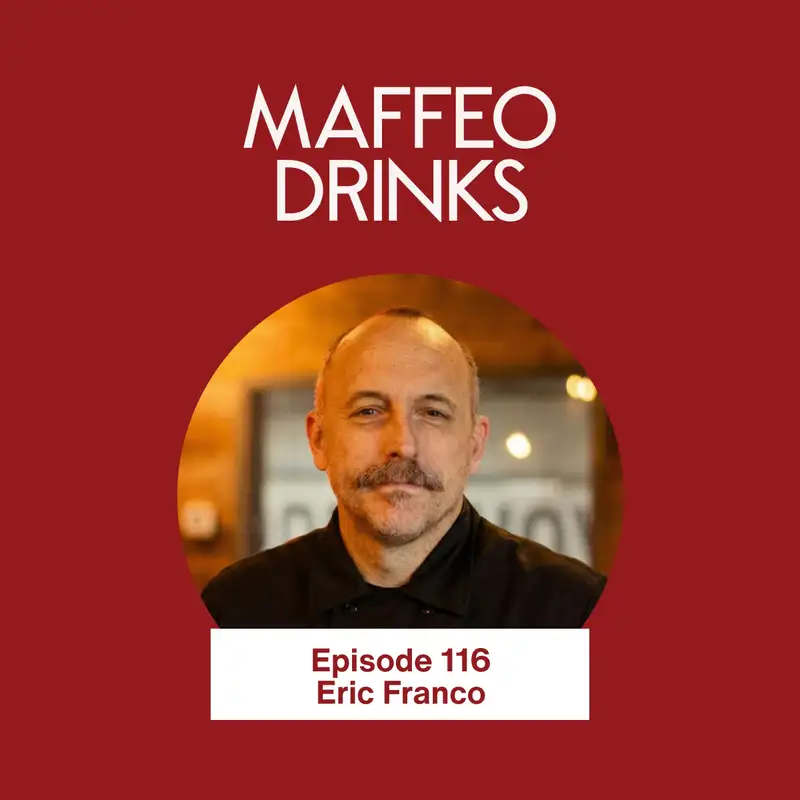
116 | Everyone Agrees Bottom-Up, Few Execute It: Eric Franco on Why Funding Pressure Makes You Skip What You Know Works
Ciao, Eric. Welcome to MAFFEO DRINKS.
Eric Franco:Chris, how are you?
Chris Maffeo:I'm fine. Thank you. What about you?
Eric Franco:I'm well, man. It's been it's been a little while.
Chris Maffeo:So just for the listeners to get into the mood, Eric and I used to work together in back in SAB Miller many years ago while he was working in the US. So in this episode, we're going back to beer because lately, I'm mainly talking about other categories. I don't even think I've spoken about beer ever in the podcast. So, Eric, I think you're probably the first one if I'm not mistaken.
Eric Franco:Well, I've got a little bit of honor then. I've gotta step up, Chris. I'm ready to go and represent the category.
Chris Maffeo:Fantastic. So let's start. I mean, we've been chatting many times during these years, but you know my philosophy that brands are built bottom up. And very often, I feel that this is actually misunderstood. Not that I hold, the truth and the definition of what bottom up means, but at least what people perceive to be bottom up sometimes is it's kinda like everybody has their own take on what it actually means.
Chris Maffeo:So I'd like to start with this. It's the first time I asked this question to a guest. So what is bottom up for you?
Eric Franco:Yeah. And I think it's a really good question because, you know, as you know, and that we don't go into the background too much, but I was an entrepreneur. That's how I got into the industry, right, as as a bar owner, tavern owner. And I think for me, the foundation of my business and subsequently my career over the last x number of years has been bottom up. And so I think bottom up to me really means foundational building.
Eric Franco:The building blocks you have to have to really be successful at any level and whether that's that you own a brand, whether you represent a brand, sell a brand, etcetera. I think having the building blocks, Chris, and having those as always kind of your foundational learning and your go to always as you sell and continue to evolve your brand is really critical. I think too many people don't necessarily build the foundation strong. They try to get ahead especially in today's world when a lot of brands are looking for acquisition or they want to drive strong valuation and whether that's in beer or spirits or other. To me, Bill, I think skip that bottom up approach where you gotta have the voice architecture right for your brand, which then influences your marketing, which then influences how you want your team to sell your brand and your wholesaler to represent the brand.
Eric Franco:So that's an example of for me, it's about building foundational blocks of your business and your brands. If you do that right or you do that really well and you always use that as your baseline, I think more times than not, you have a good successful business and brand.
Chris Maffeo:For me, it is mainly the plumbing, I like to call it, of brand building is very often skipped because we tend to focus on the shiny objects, the marketing stuff, the packaging, all the communication assets, which are, especially for a founder, very important because that's how you build your brand. So you focus on the liquid. You focus on all the aspects of the product until you basically have to open the door, open the front door, and go out in the trade, and that's where the rubber Yeah. Hits the road kind of thing.
Eric Franco:Well, I think the other thing, Chris, too is is you build your brand. You have that architecture of brand, which you and I have talked about many, many times, and we learned through the PhD of SAB and other brands we've worked on. But I think also it's the expectation of what you want your brand to be. You want this to be a legacy twenty, thirty year brand? Do you wanna sell your brand?
Eric Franco:Do you wanna create a valuation and then sell it or get acquired? I think a lot of those things become unrealistic as baseline or foundation or bottom up approach. Right? I think too many people try to go too fast or too wide, and to your point, don't take the steps needed to build that foundation bottom up. They try to go midterm or they look at the end result versus, hey.
Eric Franco:You know what? I've gotta do these things and these steps to get to that point, And it's not easy. I follow you obviously, and I comment a lot on the information and and the podcast you put out. I think at least on the beer side, too many people, at least in The US, are just trying to go so fast, and their business plans require such pressure on the base that they don't have the foundation to really extend that. Right?
Eric Franco:And so then it becomes really highly problematic in the market when you have a three tier system, and you have to invest a lot in your brands. And if you don't have that foundation and you haven't built it up and you don't have the mentality of bottom up, really tough.
Chris Maffeo:We'll talk about The US a little bit later, but let's dive into the, probably, the reasons why, you know, people do that now. Because, you know, very often when I talk to people is that we usually agree on most of the stuff, whether it's a super senior VP director in a company, in a big company with big numbers, whether he's a founder. You know, like the theory, everybody agrees with the kind of principles of what bottom up means. Now we were discussing with Morris Doyle in a previous episode, and he said something that I really loved and stole. You know?
Chris Maffeo:That is a principle is only a principle if it costs you money. It's the walking the talk that is difficult. I like to say that bottom up ultimately means growing at the right pace without jeopardizing your future. You know? And the right pace, there's no secret formula.
Chris Maffeo:I cannot give you a thousand hectoliters or 10,009 liter cases. There's no magic number to say, now I've done it, and what do we do now? But it's about feeling at least and then putting some hard numbers on that. So why do you think it's so difficult to actually walk the talk when we're building brands?
Eric Franco:I think a lot of times, Chris, it's human nature to want more more quickly. I think we're in a society in in an era where immediate gratification is something that we all have access to through our phones and through all the technology. And I think in business, it's no different. And especially when you own a brand, you want your brand to have a trajectory of quick adoption and consideration with the consumer. And so I think what happens is we put unrealistic expectations on the brand and or the brand planning, maybe the overall approach to how you wanna grow your business.
Eric Franco:And it really makes the equation very complex because to do the things that people very often say they wanna do with their brand, if it's their own brand or if it's us representing a brand, it becomes very apparent quickly that you wanna go from x or baby steps and issue you know, your your launch, if you will, to being in a Tesco or being in the largest retailers in The US or wherever your brand exists. Or to your point, you know, you live overseas. I'm here in The US. Or I wanna be a global brand, so I wanna go and distribute a brand from The EU to US immediately, and I wanna be in total wine, etcetera, etcetera. So I think that there's an impatience about building those foundational blocks.
Eric Franco:You talk about one bottle at a time. You talk about one pour at a time with a bartender in an on prem as an example. I think people really, really struggle with, I'm not going to scale quickly, and I've gotta really work this really, really hard for the first probably three years before I get into an opportunity of really authentically and then organically scaling it maybe the more effective way. I think people would just want that immediate gratification.
Chris Maffeo:That's a great way of looking at it. And sometimes I feel that people take it too big of a bite that they can't chew. And and sometimes, is it actually that you wanna grow very fast or is it that you have to justify, for example, the money you asked with the growth that you're expected to pursue. Very often, it's kinda like this chicken and egg now because there's a lot of people talking about bootstrapping. Some people are crowdfunding.
Chris Maffeo:Some people are raising capital, VC money, whatever that is. But sometimes probably you are making a business case that is not actually sustainable in that time horizon that you are expecting. But now the music is on, and you have to dance. So maybe the music should be a little bit lower, and then maybe you should walk before you start dancing with a very techno beats.
Eric Franco:No. You're not wrong, Chris. And I think I think that's the that's the dynamic we're in where in today's beverage world, right, again, spirits, wine, non alk, whatever that is. I think too many people either if that's a new brand, they get into it and they see the shiny to your point earlier, they see the shiny kind of objective that others have maybe attained. And, again, what's really difficult is that you go on Instagram, you go on social media, and you see these brands and you see these, you know, brand new brands of three years old, and all of a sudden, they've been acquired for hundreds of millions of dollars.
Eric Franco:And so they think to yourself, you know what? I can do that. That's an oddity. That's very, very, very rare. Right?
Eric Franco:And there's a lot of luck, a lot of really good skill and thinking behind those brands. But I think too many people have unrealistic expectations to your point. I I use my own experience as a bar owner as one of the reasons why I think I've been moderately successful for over the long term in working for global brands and other kinds of companies is I had that experience of having my own business at a very young age, but I had to work that business every day. I woke up at 7AM. I had to open it.
Eric Franco:I had to get it cleaned. I had to do all the things to get the bar open. I worked the bar. I didn't have someone necessarily managing the bar for me, so I was owner operator. I closed at 2AM.
Eric Franco:I had to do the inventories until 4AM, and then I woke up at seven again. And I think that understanding of your business, what you can do and what you can't do, what the limits of your brand are, whether it's a, you know, four wall environment or one of the brands behind you on your shelf, knowing those limits and not extending past those limits, I think, is difficult for people because it is. It's exciting. It's a fun industry, and you think there's potential. But too often, I think people get over the tips of their skis, if you will, and and don't realize the the really heavy implication of not building that bottom up or that foundation and having that strong.
Eric Franco:It's tough. You know? Because you've mentioned before, Chris, too many people bring on a VP of sales immediately, and they've got two employees, and they pay someone x number of dollars, or they bring on an army of people when realistically, as a founder, you can go out and spend five, eight, ten, twelve hours a day in the market selling, telling your story, selling your brand.
Chris Maffeo:I think it's very crucial one aspect that you mentioned earlier. The fact that we are in a fun business, and we are in something that gives us passion more or less. Some people are more or less passionate about it, but when you take a founder kind of person, they've created that thing. They had that inspiration, and they feel that the world is waiting for that. Or you're working for a brand, and then we've been there.
Chris Maffeo:We've been working with amazing brands, the Peronis and Miller and Coors. You know? All these brands, when you see all these motivational videos and marketing campaigns, billboards, you feel the energy of those brands. So it's very easy to say, like, of course, everybody wants this. And it's, you know, the these assets that I've created, the the packaging, the liquid, you know, it's so fantastic that what could go wrong.
Chris Maffeo:You know? Well, many things we know. But also on the other element, we because we see a lot of stuff on social media, we what you were saying before, we tend to mentally take the outliers and pretending they are the norm. You know? So when you see the casamigos of the world and, you know, all these fantastic, fanta stories and the Aperol Spritzes and so on, you know, whether you are in a company and then the Aperol Spritz example is the kind of thing that we can conquer the world, or if you are a founder, especially in the agave world or in, you know, whiskey or gin, you know, then all of a sudden it's like, yeah.
Chris Maffeo:But, you know, aviation gin sold for whatever. And then Casamigos sold for whatever. And so instead of thinking, okay. Those are the outliers. I need to really walk the baby steps at the beginning, and then maybe if I'm lucky, I will win the lottery.
Chris Maffeo:Many people enter the business thinking they will win the lottery. It's just a matter of time. And then it becomes this continuous fight between dreams and reality, and then navigating that becomes very, very complicated.
Eric Franco:Chris, I think you said something really interesting to the fact that, you know, you can't build a business on the on the lottery. Right? And so you can't build a business thinking that your the plan is to win the lottery. Right? You have to build a business that will inspire people to think that that's a lottery ticket.
Eric Franco:It's different. Right? And the mentality has to be that you're you're unique to your own brand. You're building that brand to be x. It has to be unique to yourself.
Eric Franco:It has to be unique to what you're creating. Because if it doesn't have that authenticity, if it doesn't have that foundational, in my opinion, that architecture and that voice, and and you haven't done the work to identify, yes, of course, who your competitor is. Yes, of course, who the demographic and the consumer would be. Yes, of course, you know, how you're gonna work through the channels and classes of trade and how you're gonna market the brand. Those are all things that are critical as you and I both know.
Eric Franco:But before that, you have to really understand your mission and the vision. You have to understand the voice and architecture of your brand. If you do that and, yeah, let's say you wanna go and compete against aviation or Terra Mana or whoever the brand is. Great. Cool.
Eric Franco:If that's your competitor. But you can't copy and paste. And that's what's so easy about today's world is there's a copy and paste culture, and I think a lot of that is in beverage moving forward. There's so many brands. And so what happens, it's easy to go get a co packer and go create a formulation and go buy excess tequila or whiskey down in Indiana or wherever.
Eric Franco:Pretty easy to do that. It's easy to slap a label, but what happens, it's not easy to create a legacy brand that then becomes a lottery ticket versus trying to build something to be a lottery ticket, if that makes sense.
Chris Maffeo:There's a couple of elements there now. You mentioned before the VP of sales, the sales director, a bunch of brand ambassadors, salespeople hitting the streets because it's in the business plan kind of thing. Your investors gave you the money based on that fact that Eric is not going to go out there and sell because Eric is in the distillery or in the brewery, and that's not the person that is supposed to do that. When I talk to some people, it's all almost a feeling like, yeah, but that's not my job. But if you are the founder, if you are the creator, if you are the manager, it's such a small operation at the beginning that you are everything.
Chris Maffeo:You cannot delegate something that you haven't mastered. And then there is the other element, which is kinda like the managing expectation. I'm talking a lot lately about bridging the bottom up reality with the top down expectations Because be careful what you wish for. Because if you have sold that dream, the lottery dream to your investors or stakeholders, then you have to navigate that maybe they were working for a big company. They were used to certain kind of things, and now they expect to see them in the investor deck, in the business plan, but that's not how necessary works for a small brand.
Chris Maffeo:So so there is this dual element that I feel is tough to navigate. On the one hand, I don't want to do certain things because they are not scalable at the moment. I cannot waste my time doing that. On the other end, I need scale, so I need to hire four salespeople. But if you don't know back to your architecture, communication, messaging, if you don't know what they should talk about because you have never done it, it's just in your brain.
Chris Maffeo:You've never actually expressed it outside your bubble, which is other distillers that loved it, other brewers that loved it, your friends and family that loved it. And now it's about going to the master degree. It's like you're talking to a professor who has to buy it.
Eric Franco:Well, I'll I'll I'll and I all of those things are fascinating. And I mean, you and I could talk for hours and probably days on this subject. You know, I think the one thing for me is because it has four wheels, a Lexus that you buy or an incredible and even a Mercedes that you buy off the showroom floor today does not because it has four wheels and a motor, it it drives differently than a Formula one car. So if you're building a Formula one and that's the type of race you wanna participate in, you have to understand what that is to your point. There's complexities.
Eric Franco:If you wanna drive it right off the showroom floor and you wanna have something that's a little more applicable to everyday life, you have to drive it and care for it in a different way. And you have to really, really think about what your plan is. I think the difficulty too, Chris, is depending on the marketplace. You know, you talk about the entree a lot, and you and I both have that affinity for the entree. That's actually how we met.
Eric Franco:Right? Yes. Is I still believe even though the the entree probably will have changed forever after, you know, after the COVID, it it's still the place where brands come to life. It's still a place where you have ambassadors of servers and mixologists and bartenders that are bringing your brand to life every single day to consumers. Too many people and, again, I only speak.
Eric Franco:It's not just for The US, but, you know, I've recently worked for a brand that had very large distribution and grocery, right, overseas. Too many people want to go into that to your point earlier of the big business. So they they automatically start with grocery and liquor in those big channels. Your brand acts differently there. The requirements to your point earlier of of investment of who you hire, how you sell.
Eric Franco:You're no longer selling door to door. Now you're selling to a buyer that distributes your brand or has the responsibility of representing your brand and distributing your brand to 200 plus stores. You get that distribution. You really feel good about it, and then you realize this is a different play. The rate of sales different, how you touch the brand is different, how you market the brand, the lack of touch is different versus to your point.
Eric Franco:Maybe don't hire someone. Maybe go out and spend that time. Talk about your story as an owner, founder. People appreciate that that development and that story. I think it's the storytelling too that has gone away where I've been fortunate enough to work for some owner operate or owners of brands that started out, and they worked it.
Eric Franco:They actually went out and sold, and they were up on the packaging line in the middle of the night. And then they go out and they'd sell, and they'd go to the bars, and they do the promotions, and they do the samplings. You learn more about your brand that way than by putting it on a shelf day one when you haven't really understood how the retailer and the consumer interacts with your brand.
Chris Maffeo:There's a lot of myths to be debunked because we go back to the big business, the big expectations kind of thing. Sometimes you want to look bigger than you are or maybe because you work in a big company before and you were used to that certain kind of play, you think that that's normal. You think that that's the norm. No? You want to play a game that your earlier example, you know, like the formula one and then the regular kinda like driving car are two different kind of beasts.
Chris Maffeo:Same thing goes with on and off trade. Sometimes people want to jump into off trade, and I'm always saying, be careful what you wish for because you need tanks. You don't need infantry anymore. Yep. But at the same time, the misconception is that very often those outlets, like your brand is so small that the rotation and the rate of sale, the velocity is gonna be very similar to an on trade venue.
Chris Maffeo:Anyway, you're gonna sell maybe, like, one, two, three bottles a week on a supermarket shelf if you're lucky because nobody knows your brand. So the ambition of going and getting that distribution out, people misunderstand the fact that once you're out there, you are burnt. There's no other planet to go to. Ones that you messed up with one chain, you know, in certain countries, I mean, there are three, four chains of supermarkets. So, basically, you burn 25% of your off trade growth in that market.
Chris Maffeo:So very often, it's about, okay, why don't we take again, like, baby steps? And I don't mean, like, grow slowly, but make baby steps in terms of learnings and then start running when you see that there is enough space to run, not 30 square meters kind of apartments. You know?
Eric Franco:Yeah. And I think it goes back to the business model. Right? You and I worked at the blue chip global brands where there's a pressure. The volume has to be there.
Eric Franco:Right? There's no there's such demands on the business that there the expectation is very, very high. If you're starting out and have a smaller brand, depending on how your business is set up. Right? If you to your point earlier, if you raise capital and you did a pre seed round and now you're at a seed round and now you've raised 2 and a half million dollars, someone wants their investment back depending on the model and who you've partnered with.
Eric Franco:So there's an immediate pressure, I think, to go the route of, let's say, grocery or liquor or whatever that is to your point. And a lot of people getting into the business know the business, but even then, the threshold on rate of sale, all the little things that you don't think about always come into play, and it is very complex. I think the other thing you said interestingly too is this is why I love the on trade. I like the off trade as well because it does provide you obviously scale. And in The US, that's where a lot of the volume is.
Eric Franco:But I you mentioned in spirits as an example. It's one bottle at a time. Right? So if you're at a Total Wine and More and you're you have shelf placement in in the store, you're selling that one bottle at a time. To your point, that's the all you can do there.
Eric Franco:Yes. If they have a sampling program, you can sample. But, realistically, your brand's on the shelf, and it has to pull with the consumer based on what the consumer sees or what they look for. Right? The percentage of your success is gonna be dependent on many factors.
Eric Franco:Bottom up to me also means creating ambassadorship, creating affinity for your brand, and you don't do that in a liquor store. You can go as you've mentioned many times on your podcast and in in your writings, you can go to a local down the street. You can earn their business, and then you start interacting with that bartender. And then you get on the menu, and then you help create a solution of cocktails and the things that are really exciting for people. And you maybe earn the opportunity to have your brand represented in multiple cocktails on that menu.
Eric Franco:So now all of a sudden to your point, you're pouring that same individual bottle, but your brand has multiple avenues within that one outlet versus being on the shelf at the liquor store. So it's that bottom up mentality and the ability to create affinity for your brands multiple ways, and it can be done off trade as well. But in the chain business, as you know, it puts an exorbitant pressure on the business out of the gate, which makes people do really crazy things. Mhmm.
Chris Maffeo:You mentioned that the pop down the road or the bar down the road. Do you think that many brands are kind of skipping they're fast forwarding the their home turf. You know? That there is this tendency I I see that the grass is greener on the other side. So I need to go and sell in that state because it's easier than my state or that country.
Chris Maffeo:Because whenever they see a wall, then they say, okay. Probably on the other side, there's no walls. You know? While very often, it's actually the same wall. It's just that you need to learn how to climb that wall instead of, like, running away from that wall.
Chris Maffeo:Do you see that kind of aspect?
Eric Franco:Yeah. Chris, I think that's a that's a huge challenge for brands in in The US for sure. I think what happens is because, as we mentioned, if you start with chain and your objective out of the gate is to be at Target, because Target's a national player, and the only way you really get a ton of Target business is by being in the multiple states that Target operates at. Right? You have a better chance of getting into the targets of the Walmarts or the big players that cross different state lines by being offered in those different states.
Eric Franco:Right? There's that requirement. So I think what happens is that people, because they have these really cool opportunities or think that they wanna go bigger, They try to expand themselves so they can actually get those chains to show interest in their brand. Right? So the end goal is to get into that chain.
Eric Franco:There's some really good examples in The US of breweries in particular, but even spirit companies that have stayed local and have really earned their keep in their home states, and they've been very successful. Right? There's a couple here in the Midwest that, again, are still exclusively distributed in one state. And so while maybe that's in the mid teen, clearly, modeled has worked. Clearly, they've generated revenue and had success.
Eric Franco:And I've also seen that when certain companies have taken that approach and then look at adjacent states versus, hey. I'm in Michigan, and I wanna go distribute it in in Hawaii or California. That very often doesn't work because there is regionality. There is this affinity for local and regional brands. You don't typically have the same profile that a Midwest IPA drinker would have than a California IPA drinker had.
Eric Franco:There are different styles that represent different kind of occasions and what the palate is. Too often, you go too wide. So it definitely happens, especially here in The US. It's just very complex, but also part of the model that I think people take.
Chris Maffeo:There's a couple of points. One is if we go back to the walk in the talk or sticking to your principles, the principle is only a principle if it costs you money. Opportunity element. Very often, apart from the business plan or whatever, you know, there is an opportunity that pops up, and it's about understanding, is this going to jeopardize my future or not, or is it a real opportunity? So some opportunities may be misleading opportunities.
Chris Maffeo:And to that example, now it's like, hey. Target is interesting and is interested. So should we go for it? You know? But maybe you are in a handful of bars that you're selling.
Chris Maffeo:So is it the right time? Maybe you don't burn your yourself if you don't go with Target yet. But if you go and it doesn't rotate, then will you get a next opportunity at Target when you get delisted? Well, you
Eric Franco:won't, and you know that. When and I think, again, the reality is you won't earn that second opportunity, whether it's in The UK or EU or here. Right? It it's and not only does it and let's say you have distribution. Even if you try to push a second brand in that isn't right for that retailer or it's not right for the consumer base or the occasions, that brand doesn't work.
Eric Franco:It has negative equity on the brand you already have in that store. Right? So you have to be really careful on how you approach each of those retailers. You and I have had long conversations as well. It's the lost art of segmentation.
Eric Franco:Part of that bottom up approach too is about segmentation, and Pareto's law applies here too in beverage. Right? 80% of your volume will be done in 20% of the outlets that you are distributed in. That's just the reality of it. And so if you build bottom up and you work with your wholesaler in whatever country you are, however that system is, understanding the right accounts for your brand.
Eric Franco:You know, it's easy to get distribution. Right? If you have a wholesaler and you put an incentive, they're gonna sell their their staff will go out and sell your product, and they'll put it into places it doesn't belong. They'll put it into a place that it'll sit there for six months. It'll be one did buy, and they'll never rebuy.
Eric Franco:So I think the approach and the mindset continues to challenge us to be more efficient with our time and more specific to what our brand represents. You know, Jaeger's a good example. Jaeger obviously plays in on off all of the channels and globally. But how you sell it and how you nuance, it would be interesting to to tell the story of how that brand was brought to life. You know, how how certain brands like Jack Daniel's, Cleary, Heritage brands, where did that start?
Eric Franco:Where did they start selling? How did they start selling? Even brands that are fairly new. Right? You look at, like, at a liquid death, which is, you know, a completely different scenario.
Eric Franco:Clearly, they had a really, really tight proposition, knew their brand, knew exactly where they wanted to go, started in small format, and dominated that and then built out further value into all of the other classes of trade and look at the brand and
Chris Maffeo:what it's done. Owning that kind of occasion and that place in the mindset of consumers. Now if you go back to the usual example of Aperol Spritz, but the Peroni would be the same example. You go to an Italian restaurant, you are sitting outside, you know, the corona of the world, the soul corona, they own that kind of moment of I put the lime in and I'm on holidays. They own that state of mind.
Chris Maffeo:Is that kinda like the Guinness element, you know, when you go to a pub? There are brands that manage to, through consistency, to really own that space. If I work into a pub in England, I'm always going for Guinness. It's just like a no brainer for me that it owns that place in my brain. And if we go back to the second question I wanted to ask you, instead of going to an ideation space and state, you go to whatever, West Coast, East Coast.
Chris Maffeo:You skip the regular normal places to go to the fancy ones. No? It's it's very often what happens. Like, the people when we go back to that regionality element, you say, I live in this state. It's not really like a fancy state or it's not a fancy city.
Chris Maffeo:So rather than owning my home turf, I need to go to New York. I need to go to LA. I need to go to San Francisco. That's where the money is. That's where the opportunities are.
Chris Maffeo:Let's wrap this up. What are the final thoughts about this?
Eric Franco:No. I appreciate that, Chris. I think, one, congratulations to you. I think talking about the industry and talking about foundational elements of what makes this industry great through your philosophy and through your experience and and sharing that, I think, is great. So congratulations to you, man.
Eric Franco:I'm I'm proud to to call you an amigo and and having worked with you and for the opportunity today.
Creators and Guests