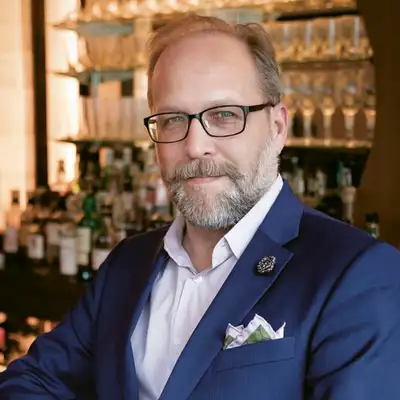
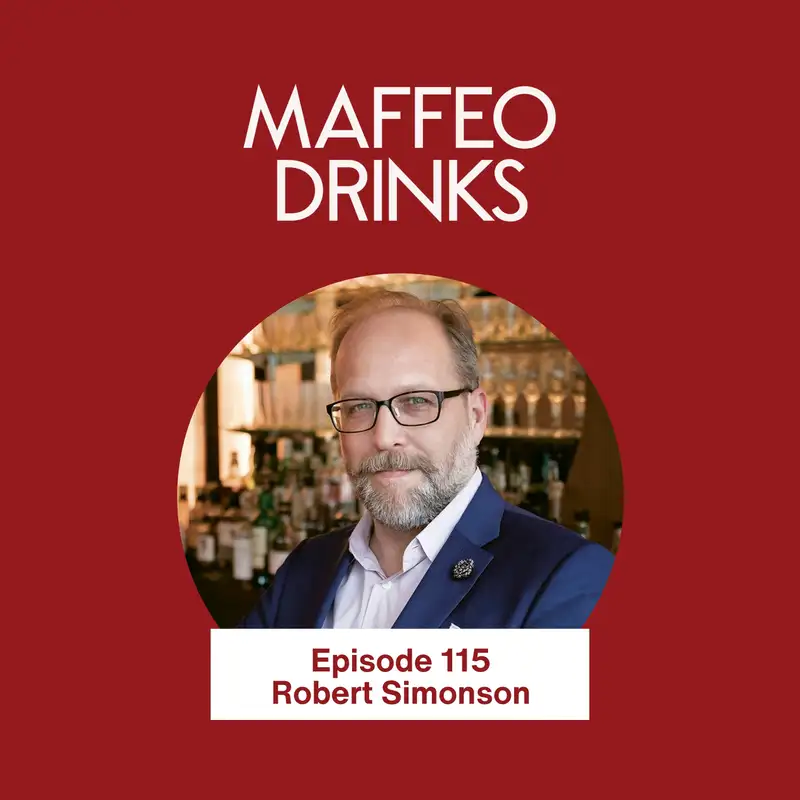
115 | Why The Cocktail Renaissance Was Built Bottom-up: Author Robert Simonson on Documenting Cocktail History While It Happens
Hi, Robert. Welcome to Maffeo Drinks.
Robert Simonson:Thank you. Happy to be here.
Chris Maffeo:Fantastic. It's a real honor to have you because, I mean, I read a few of your books, and I listened to many of the podcasts with you. So I feel I know you somehow, but we'll see now how we explore different topics that we are both passionate about.
Robert Simonson:Looking forward to it.
Chris Maffeo:So let's start with a few questions. The main inspiration for this was your book A Proper Drink that I heard on a previous podcast that is your favorite if I'm not mistaken.
Robert Simonson:Yeah, I've written seven cocktail books at this point. I have another one coming out next year, but it is my favorite. It's different from all the others. It was actually the second cocktail book I wrote. And looking back, I can't believe that I actually did it because it was incredibly ambitious.
Robert Simonson:Probably I would not even try to do it if I tried to do it today. But my aim was to write down the history of the modern cocktail revival while it was still happening and while all the people who created it were still around. So I think I managed to do that and it came out in 2016. There it is.
Chris Maffeo:Fantastic. It's one of those books that I honestly, I keep it on my bedside table together with others. And and I go back at it because it's it's really nice the way it's done with chapters, and you can go and, you know, deep dive into one particular chapter or read it all at once. But it's it's super fascinating because, I mean, it feels like 10 books in one.
Robert Simonson:Yeah. I hope people do use it, especially bartenders and bar owners as a reference book, you know, just because even though it's recent history, it's possible to forget all this stuff.
Chris Maffeo:Absolutely. And one of the reasons why I do this is to keep the legacy of my great grandfather and my grandfather that were distributors in Southern Italy. That knowledge went unfortunately lost. I have some memories from what my father told me, but it's such a shame that you always take things for granted. And then all of a sudden, you don't realize how fantastic knowledge can disappear overnight if you don't archive it and document it properly.
Robert Simonson:That's true. And I think that's actually what's happening right now. People worked really hard for about twenty, twenty five years to make cocktails come back and craft bartending come back. And now I think probably the new generation is taking it for granted. They think it's always been this way that we've always had these wonderful products.
Robert Simonson:We've always had these wonderful tools, the skills, the history, but we haven't always had it. And you should never take it for granted. You have to keep learning. Keep reading.
Chris Maffeo:Absolutely. And we'll talk about that a little bit later. But let's dive into the you know, you mentioned the the cocktail renaissance or the cocktail revival, how different people call it. But what happened? Like, how did that restart when New York, London and the differences between the the two sides of The Atlantic?
Robert Simonson:Yeah. I think there are a lot of answers to that. It sort of happened independently in several cities at once. People didn't know what the others were doing. For instance, here in New York, we had a man named Dale Degroff and he was a bartender.
Robert Simonson:He was asked by his boss, Joe Baum, who was a very famous restaurateur here in New York and opened many famous restaurants. He was going to reopen the rainbow room, which was this classic 1930s art deco restaurant in the sky. And he wanted there to be a bar that served classic cocktails, pre prohibition cocktails, and nobody was doing that correctly anymore. So he charged Dale with doing this. He had Dale go buy a copy of Jerry Thomas' out of print 1862 bar manual.
Robert Simonson:And so Dale started doing this in '87 and because it was new and novel, know, everything old is new again, people started writing about it, journalists writing about it, and patrons started noticing it. And so that sort of started getting it rolling in New York. It took about fifteen years before it really became bigger than the Rainbow Room. And something similar happened in London with a guy named Dick Bradsell, you know, and he started toying around with classic cocktails. Of course, London never had to deal with prohibition like America did, so they hadn't forgotten as much as we had.
Robert Simonson:And it started happening in Australia as well. San Francisco was separate. San Francisco had a very, there are certain cities in America that never forgot cocktail culture completely. New Orleans is one of them and San Francisco was another one, but they drank kind of differently. In San Francisco, have this wonderful produce and it's warm, you know, twelve months out of the year.
Robert Simonson:And so you get all the citrus. They had Pisco Sours, and they had Mojitos. New York was a hard drinking town. We drank martinis in Manhattans.
Chris Maffeo:What is interesting to hear from you is that it happened separately. It was almost like an independent phenomenon that many people started and go back to.
Robert Simonson:Yes. I mean, the Internet was in its infancy, and the cocktail revival marched hand in hand with the arrival of the World Wide Web, the Internet. There were a few chat rooms where cocktail geeks would get together and exchange notes and thoughts, but, really, things had to travel by word-of-mouth. So some bartender who was trying to get the old fashioned right in San Francisco might not know that the same bartender in New York was trying to do the exact same thing. I think it was just a natural progression in The United States.
Robert Simonson:From the seventies on we rediscovered all the things that we were eating and drinking and tried to do them better. And so in the seventies, we got away from the convenience culture where everything was in a can or frozen or, you know, sour mix on a gun and tried to make fresh, fresh food from scratch using the fresh ingredients like Chez Panisse in San Francisco famously and places like that. And then there was a beer revolution where we tried to make better beer, craft beer. We rediscovered our own wines in California, discovered what good wine was. So the only thing that was left was cocktails and spirits.
Robert Simonson:It was the last piece of the puzzle. And when you got around to the late nineties, early aughts, people started thinking, you know, what are cocktails? We used to be famous for them. We used to drink them all the time. They must have been good once upon a time, so they're not good now.
Robert Simonson:So let's go back to the old books and figure out how they used to be made. And the same went with spirits. You know, we're not necessarily drinking the best whiskey, the best gin. Let's explore this.
Chris Maffeo:It's interesting how the history repeats itself, know, and then there's all these waves of forgetting and then trying to go back at it and doing it better and rediscovering things and then all this kinda like legends and myths also appear in in the game.
Robert Simonson:Yeah. No. Bartenders really had to go back and rediscover their profession, you know, from the bottom up. It was it was quite a Herculean task. I don't I don't I don't know if people today actually realize how hard it was to get back to where we are now.
Chris Maffeo:Absolutely. We'll talk later about this, but we live in this social media kinda like driven, you know, connections, contacts. It's at our fingerprints. Back in the days, what was interesting reading in your book is that, for example, if you take us, there was no contact almost between London and New York until a certain point. But also within New York City, as I understand it, it was more of a silo mentality.
Chris Maffeo:Everyone was doing their own thing, if I understood correctly.
Robert Simonson:Yeah. If you're talking about the nineties and the early aughts, it was a bunch of people, like a few people just working separately in different restaurants and bars. And there really wasn't a community. I think there was more of a community in London than there was in New York. I don't think we really got a community here in New York until Sasha Petrosky opened Milk and Honey in 2000.
Robert Simonson:And then people started writing about it and bartenders started going there. And of course Dale DeGroff played a role in publicizing, helping get that milk and honey get known. After that, it sort of reached a crescendo. There was this convention down in New Orleans called Tales of the Cottail, which started in 2002. And so that helped a great deal because it gave all these people a place to go once a year to meet each other and exchange ideas.
Chris Maffeo:When I was reading the book, I mean, within the city differences than within a state differences. LA versus San Francisco, for example, London versus New York. The Australian kind of game. And it was very interesting to see how going back, it was really done bottom up, but it was very often one single person moving country or moving city, bringing all wealth of knowledge from that. Right.
Chris Maffeo:Right?
Robert Simonson:I remember once when I wrote the book and, you know, some people read it and I remember this editor once coming to me and saying, with a certain kind of disbelief, you know, was it really just like one guy? They just could not believe that you've heard of the great man theory of history, that certain things begin with one person. I'm sorry, but that's the way it was. It really was a personality driven movement. This was not a movement driven by the bartender's guild or some kind of spirit corporation or restaurant association.
Robert Simonson:It wasn't an organized effort. It was just a collection of people who wanted to do their job better.
Chris Maffeo:Wow. That's so fascinating. It's very much matching my philosophy that I always say brands are built bottom up, and I really love this. The fact that really things happen. I'm a big empiricist.
Chris Maffeo:You know? I like to observe phenomena and Yeah. And then derive kinda like theories around them. You know? That I'm a big believer in that.
Chris Maffeo:And it's so fascinating to see that really, like, sometimes it was one bartender that created one cocktail, and it it's crazy when you think about it in a way.
Robert Simonson:That's why I liked it so much. I mean, I used to write about theater, and I changed my beat, and I started writing about cocktails. There was a reason why I was writing about cocktails as opposed to spirits or wine because it was this collection of personalities. Bartenders are interesting people and they're fun to talk to and they don't think the way that normal people think. And so it's much more fun and interesting to write stories about them.
Robert Simonson:Like, say, for instance, if the cocktail revival was actually created by Diageo or something like that, like, that bunch of executives in a boardroom said, I got an idea. Let's bring back craft cocktails. And I probably wouldn't write about cocktails because that's not interesting. I don't wanna write about a corporation. I wanna write about people.
Chris Maffeo:Absolutely. Like, 100%. I mean, I'll let you know. It's so fascinating. We've never spoken, but, you know, we agree on so many things.
Chris Maffeo:And I when I was listening to you on other podcasts and reading the words, I was like, shit. I mean, like, I can't believe that I found this book and, like, someone that is actually documenting this stuff because but it's honestly, it's gold, you know, the the book
Robert Simonson:that you
Chris Maffeo:wrote because it would take so much time putting this together, which probably did, by the way.
Robert Simonson:It did. It took, eighteen months. I interviewed more than 200 people. I went to France. I went to England.
Robert Simonson:I went to Australia. If I had to go back, I would have done more. I mean, it's not like they gave me money to go to these places. I had to spend my own money, but, and I was, I didn't have a lot of money back then. I don't have a lot of money back now, But but if I had it to do over again, would have made a trip to Germany.
Robert Simonson:There was a lot of stuff going on there. I I would have gone to Tokyo. I mean, is in the book, but I didn't travel to Tokyo. Yeah. I think I did a pretty good job.
Chris Maffeo:Let's dive a little bit more into this. So for example, you mentioned about the personalities. You speak about quite a few of them, but one of the things that I discuss very often in the podcast and also when I advise brands is about focus on an occasion, you and on a drink. You know, many brands talk about I mean, the usual example. Overused is the Aperol Spritz as an example.
Robert Simonson:Oh, yeah.
Chris Maffeo:You know, all the gin and tonics of the world, you know, Hendrix with the cucumber and all these things. And what is really fascinating when I was thinking about, for example, you know, quite a few drinks, like, for example, if you take the margarita with Cointreau, you know, that Cointreau plays a role into that, Then the way I understood that the cosmopolitan was born was very, very much out of the same similar ingredients. You know? When Toby Cicchini, you know, with Yeah. Having Cointreau playing a role and and certain, you know, like the see throughs and all these kind of elements.
Chris Maffeo:And sometimes it's very interesting for me to see that we tend to think of drinks and drink strategies and done in an advertising agency and in a London office or in a New York office. But sometimes it's just like a random bartender taking something that was brought to him or her attention and then trying to shift it, make it better, and make it twist on it and taking the ingredients that he or she have available at that time. You know?
Robert Simonson:Yeah. I mean, the cosmopolitan is unusual. It was way before the cocktail revival got started back in the late eighties. And I don't think Toby Cicchini was trying to create a modern classic. The story he tells is he just created it as a shift drink, something for the staff to drink.
Robert Simonson:Yes. And he was working with what he had been told was the recipe of a drink called the cosmopolitan from San Francisco that wasn't very good. And so he was just trying to improve upon that. And that was real slow build slowly but surely. I remember being in New York in 1991 and it was a common drink, so it didn't really take that long.
Robert Simonson:But of course, when sex in the city came along, it exploded and everyone knew what a cosmopolitan was. The history of that drink continues to be disputed. I guess I'm on team Cicchini. I believe his story. It makes sense to me because he's a career bartender.
Robert Simonson:There are other stories of people in Florida, people in Minneapolis, people in San Francisco who supposedly created this. But, you know, I'm a big fan of Occam's razor. The most obvious answer is usually the true one.
Chris Maffeo:I agree. I'm also on that side of the story, and I listened to one of the latest episodes as well on this. And when he tells the story, I'm planning to have him on because I'd love to
Robert Simonson:Oh, Toby? Yeah. So he'd be very entertaining interview.
Chris Maffeo:I can imagine that. It's super fascinating to me when you see what's exactly what you were saying before. And it's the same thing when people try to invent a cocktail from a table, from behind the desk. You know? And then just like, okay.
Chris Maffeo:We'll put this one and this one and this one, and we'll get all the brand ambassadors and the sales guys going out there and pushing this down the throats of the bartenders. It just doesn't happen. You know?
Robert Simonson:Yeah. As far as I can tell, there have only been two instances in the past half century where that has worked. One was the Harvey Wallbanger, which definitely was pushed by the Galliano people, and they turned it into a sensation in the early seventies. And the other you just mentioned, the Aperol Spritz, undeniably a corporate cocktail that completely worked, and now we all drink it.
Chris Maffeo:Yeah. That's true. But it's also like very often in this industry especially, it's very funny how then we take the outliers and we make a rule out of an outlier, you know? And then everybody wants to create the next spritz.
Robert Simonson:Oh, yeah. No. I mean, after the Harvey Wallbanger took off in the seventies, every brand owned a liqueur, every corporation owned a liqueur, they tried to create their own version. I was in an antique store the other day, and I found this kind of bar sign for the Red Baron. The Red Baron was this terrible cocktail that was being pushed in the seventies.
Robert Simonson:I forget what was in it. I think it was vodka and grenadine or something like that. But it didn't work. They advertised the hell out of it for two years, and then they gave up.
Chris Maffeo:Let's talk more about the movement between countries with people within countries and between countries. Now there were different philosophies even within the city. If we take some of the milk and honey Mhmm. And then there were other outlets that were doing more of a speed service game, like a faster service. You know?
Chris Maffeo:There were different kind of schools. And very often, when I hear nowadays talking about cocktail culture, we tend to relegate it into this, you know, like super top class kind of cocktail culture. But there was a school of thoughts that was actually building drinks at scale, at speeds that was going parallel with the Sasha Petrosky kind of Yeah. More refined philosophy.
Robert Simonson:Yeah. At Milk and Honey, I mean, you ordered your drink and, you know, it took a little while to get it. Maybe you got it in ten or fifteen minutes because they took a lot of care creating them as if they were dishes in the kitchen that you had just ordered. You're not gonna get it in five minutes. That became one of the knocks against the cocktail revival early on that took forever to get drinks.
Robert Simonson:People were used to going up to the bar and, you know, they order a rum and Coke and they get it immediately. So a drink that takes too long is, I don't know, bad service. But the industry, they saw that immediately and they figured we have to do a little better. One of the people that helped with that was a woman named Julie Reiner. That's from Hawaii and she bartended in San Francisco for a while, and then she moved to New York and she made a reputation for herself at a small bar called the C3.
Robert Simonson:But then she opened the Flatiron Lounge in Manhattan in 2003, and she was serving craft cocktails, but it was a large space. It wasn't like milk and honey. There wasn't a reservation system like milk and honey. You could just walk in. So they had to do it to scale, you know?
Robert Simonson:So they found lots of ways to serve the drinks faster. They had little cheat bottles on the bar top, like things that you only use a little of, like chartreuse or absinthe. And some stuff got combined in bottles, like if you had some spiritus ingredients and they all went into one drink, why pick up three bottles when you can pick up one bottle? And so all these little things made things faster. So these were innovations of service as opposed to, you know, ingredients, recipes.
Robert Simonson:And that carried on, you know, and then there was Pegu Club that was kind of a combination of both milk and honey and flat iron. But there've always been both kinds. There've always been bars that pride themselves on speed and while also delivering craft cocktails and the bars that continue to do things slowly and surely. I kind of like the latter ones quite frankly, because I like to just sit at the bar. I'm I'm gonna enjoy my time at the bar.
Robert Simonson:I'd rather have my drink be good than fast, quite frankly. I
Chris Maffeo:agree. And it also goes back to certain brands or certain kind of occasions, going back to the occasion. If you are in a party kind of mode, then obviously, you're not sitting. You are standing. You are you know, it's a different kind of vibes, like a higher energy type of place.
Chris Maffeo:But then if you want to have a conversation and, you know, sitting at the bar and enjoying the the craft of what's happening, then it's another story.
Robert Simonson:Yeah. And I guess I'm not like everybody. I'm always thinking about what I'm drinking, and I think most people are at bars. They're talking with their friends. They're thinking about their day, whatever.
Robert Simonson:So but I pay a lot of attention to what's in the glass.
Chris Maffeo:That's very true. I think you were mentioning something between Australia, you know, that there was like a program that a lot of Australians were going to UK or British people were going to Australia. In Europe here we have the Erasmus program now that you can do a semester in a university of the European Union. I call it the bartender's Erasmus program. They could travel between countries and that was one of the starts of this contamination between different worlds.
Robert Simonson:Yeah. As I was researching a proper drink, there were a number of Australian bartenders in New York, and I interviewed them, people like Sam Ross and Naren Young and Linden Pride. And they started telling me like, if you really wanna do this book right, you gotta go to Australia, you gotta go to Sydney and Melbourne and talk to the people there. And I came to learn that was another separate island of cocktail creativity that happens simultaneously with London and The US. And that was mainly because there was this exchange program between the countries between Australia and UK.
Robert Simonson:If you were Australian and you wanted to go to UK to work for a while, it was very easy. They made it very easy for you. And the same was true. The British would go to Australia. And so a lot of Australian bartenders who were interested in cocktails would go to London.
Robert Simonson:Obviously, London scene was more advanced. And they'd end up working with people like Dick Bradsell, who was the godfather of the London scene, and Nick Strangeway and other people like that who were at the top of the game in the early years. And then they'd go back to Australia, back to Melbourne and Sydney. They opened their own bars bringing all those ideas with them. So it's just like cross pollination.
Chris Maffeo:I don't know if you call it a system theory that, you know, you see all these buckets and all these islands totally disconnected until a very weak link as Malcolm Gladwell would call it. Then it connects two worlds, and then all of a sudden, there is an explosion of contamination, cross pollination of trends and things that actually happen. No?
Robert Simonson:And there was New York too because not as much as London. So there was this guy named Michael Madrasen. He was Australian. He went to New York and he worked with Sasha Petrosky at Milk and Honey and and Little Branch. And then he went back to Melbourne and opened a bar with Sasha Petrosky called the the Everly, which unfortunately recently closed.
Robert Simonson:The Sasha Ideas went there. The Sasha Ideas also went to London because a guy named Jonathan Downey opened a second Milk and Honey in London. And soon everybody's sharing the same knowledge. Of course, there are differences between nations and cultures and cities, but there are a lot of similarities as well.
Chris Maffeo:Yes. And it's super fascinating for me. I mean, I'm Italian and from Rome, and, you know, we are obviously, you know, generalizing. You know? We are bitter kind of lovers now with our espresso and all the bitter flavors that we are used to since the kind of young age.
Chris Maffeo:Yeah. And it's so fascinating to see how this permeates certain type of cultures. I live here in Prague. Typical example is, you know, if you take, like it's it's quite a bitter market. Jagermeister, Bekerovka, you know, Fernet.
Chris Maffeo:One of the most common beers and pilsner Urqua, which I worked for back in the days, it's known to be one of the most bitter lagers. You know? Uh-huh. People are you know, the combination of these two, you know, is not a coincidence in my opinion. I don't have any evidence to back it up.
Chris Maffeo:But for me, it's like the fact that Czechs love bitter beer, bitter lager Yeah. On the pilsner, you know, then makes it so easier to actually, you know, translate that into spirits with a bitter kind of flavor where
Robert Simonson:Yeah.
Chris Maffeo:It would be totally different in another country. You can try to seed an acorn of a trend into a country, but it must find kinda like a fertile ground. Otherwise, it doesn't let's talk about this, you know, going back to the way cocktails were born. No? Because this is one of the things that are really fascinating for me.
Chris Maffeo:Mean, you wrote another book called Modern Cocktail, which
Robert Simonson:Modern classic cocktails.
Chris Maffeo:Modern classic cocktail where when and which is actually the first one that I bought from you after recommendation from Philip Duff, by the way. Thank you, Philip. You know, what is interesting, like, if you take a cocktail like the basil gin smash, you know, I remember you writing on the book that it was starting to be used in different countries, and then they started spotting it in different kind of countries in slightly different ways. And, you know, it wasn't the I mean, there there was already, I guess, social media because it's like what? 2008?
Chris Maffeo:Or
Robert Simonson:Yeah. I think social media did play a role in that. Jorg Meyer, who owned this bar in Hamburg called
Chris Maffeo:Yeah.
Robert Simonson:Lion. He got the idea. Actually, here's another example of that cross pollination of ideas. So he went to New York and he went to Pegu Club, which was a bar run by Audrey Saunders, who had been a protege of Dale DeGroff. And on the menu was bourbon smash, which was a cocktail associated with Dale.
Robert Simonson:Jorg had that drink and was impressed with it and it stayed in his mind. So he went back to Germany and one day he was at the green grocer and he saw that there was like a bunch of basil. And so he got some basil and he basically made a gin smash, a very simple drink. He muddled the basil at the bottom and he put the basil on top. That's very aromatic.
Robert Simonson:It gives it a different flavor. And it caught on, but I think he was very good. He was a kind of a media figure as well. You know? Within the German circles, he got around, and he just spread the word of the drink.
Robert Simonson:And it wasn't long before it became, you know, a modern classic. It's been a while since I've read that chapter in the book. You know, have to refresh my memory. But definitely that is one of the indisputable modern classics of the last twenty five years.
Chris Maffeo:What is fascinating for me is really seeing how certain trends grow within a country and then maybe they stay country specific, but then some other manage to travel. No? But also the, you know, the modern classic cocktails, it's so fascinating because we tend to always think of both the very old kind of classics. But then there is a modern era of all the, you know, like the Penicillin, the Basil Gin Smash, the
Robert Simonson:Mhmm.
Chris Maffeo:Pornstar Martini, the breakfast martini. You know, all this that I'm sure that if you talk to younger bartenders, they may think they were invented, like, you know, a hundred years ago, but, actually, they were not. You know?
Robert Simonson:No. I mean, the Pornstar Martini is what? About 30 years old now. Breakfast Martini, 35. They are becoming older, you know?
Robert Simonson:But, yeah, a lot of these young bartenders or or young consumers, you know, bar enthusiasts, drinkers, they think they're pre prohibition cocktails, which is, I guess, a testimony to the success, you know, that people think they've been around forever. People think the penicillin's been around forever. Yes. And so that's why the book's important. You know, part of the book, a proper drink has recipes.
Robert Simonson:So anything, you know, the modern classics all have recipes. And then I just kind of furthered that argument with modern classic cocktails because it's become a kind of a particular study of mine. There are certain things. I mean, you mentioned David Wondrich, the historian, and he's a friend and he used to live near me in Brooklyn. But he tends to concentrate on the past dealing with bars that don't exist and people who are no longer with us.
Robert Simonson:And I have concentrated on the modern history, you know, what's been happening since 1990 and trying to get that down because one of the problems when we were collecting all this history of cocktail history from the nineteenth century is not a lot of people had written the history down. So it was very difficult to piece it all together. So I thought, well, we shouldn't have to go through that again. Everyone's here, everyone's alive. Let's talk to them.
Robert Simonson:We have the internet, we have books, you know, let's write it down. And then, you know, people in fifty years from now are saying, you know, what the hell were they doing? You know, in the early twenty first century, all they have to do is like pick up a few books and then they find out everything that's going on that went on there. Unfortunately, I have discovered that that is actually too much to ask of people and they don't pick up the books and they still don't know what went on. And it's very frustrating.
Chris Maffeo:Let's hope that more and more people I'm doing my bit to give your book as a Christmas present to my friends, to people that appreciate that because it's really super interesting, honestly. And what just came to my mind when I was talking about Italy and flavors that there was a drink and now I can't remember the name of the bartender that created this drink that resembles a manachan.
Robert Simonson:What you mean? Americo?
Chris Maffeo:Maybe. What's the
Robert Simonson:name the Red Hook?
Chris Maffeo:Yes. The red hook. Yeah. When I read the recipe of the red hook, I was like, shit. This is my drink.
Chris Maffeo:You know? I love it. You know? But I've never heard of it until then. I've never seen it.
Chris Maffeo:But when I saw the recipes and then I saw that it was an Italian making it, I was like, this is not a coincidence. You know? No. Because whenever I go into a bar, I'm always into Negroni is my go to cocktail. And an oldie, the vermouth, bitter, and hard liquor kind of combinations.
Chris Maffeo:You know, like the mezcal Negroni when I was at the Nomad in New York last time I was there. I was introduced to that. You know, the Boulevardier is another of my big Yeah. And because I love that level of, you know, this witness of the red vermouth and the bit you know, the bitterness of the bitter. No?
Chris Maffeo:Yeah. And then I always noticed that depending where I go, you know, there is always like I mean, obviously, there's tons of Italian bartenders out there, but we tend to have the same kind of palate. You know? You can I mean, I'm quite well traveled around the world? I lived in many different countries, but I cannot taste my taste buds after a certain level.
Chris Maffeo:I don't drink sours and very often I see how, you know, a bartender is making a certain list of cocktails and they default to certain type of patterns and taste profiles that are ultimately coming from their origin somehow.
Robert Simonson:Mhmm. Yeah. Lately in my travels, I've come to Italy quite a bit and Italy among the nations was a little later as far as adapting the cocktail revival. But lately I've been to Milan and I've been to Florence and I've been to Rome and Naples, and all these cities have great craft cocktail scenes right now. But in those earlier years, the Italians did have a role because it was mainly about what Italians were doing in other countries.
Robert Simonson:In London, you had people like Salvatore Calabresi and Peter Dorelli and other Italians. They were very prominent in the London scene and created some of the early modern classics. And in New York, we had Enzo over at he worked at Milk and Honey. And, Sasha had brought him over from London, and that's where he invented the Red Hook. And the Red Hook was a very influential cocktail.
Robert Simonson:It spawned many other Manhattan and Brooklyn variations. And then he has his own bar in Ischia now, which I was happy to visit about four years ago. So if you're ever in Ischia, you can get a great craft cocktail at this one.
Chris Maffeo:So let's wrap this up. What are some final thoughts from you?
Robert Simonson:Well, I'm just going to keep a chronicling it. I think that's part of my job to like keep chronicling this history and keep reminding people of the recent history. I think it's important that the people out there who are interested in cocktails and spirits, and they're going online to find out about things, they have to understand that, I mean, I wrote during this period of this lucky period of time, you know, when newspapers and magazines were actually interested in the stories, the stories of these new bars, these new bartenders, these new cocktails, and why this is all happening.
Chris Maffeo:100%. So thanks thanks a lot, Robert. It was a great great honor and great great chat.
Creators and Guests