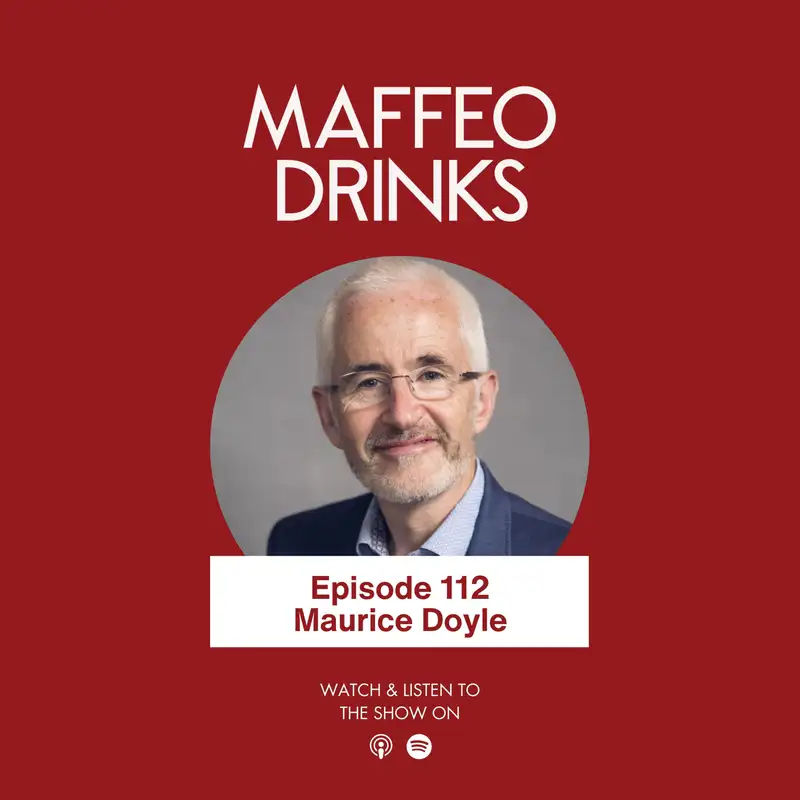
Winning Without Deep Pockets: Maurice Doyle on Capital-Efficient Drinks Growth | 112
Summary
Maurice Doyle returns to MAFFEO DRINKS to dissect the drinks industry's inflection point, where COVID's artificial peak has given way to a "new reality" of capital constraints and complexity. Drawing from his veteran experience across major spirits and scale-up companies, Maurice reveals how brands can achieve growth without abundant funding by focusing ruthlessly on strategy, particularly what NOT to do. The conversation explores the tension between principles and tactics, why "I don't know" might be the most powerful leadership phrase, and how misaligned expectations between bottom-up brand building and top-down objectives create systemic friction. Maurice's core insight: in a world where 95% of your target market isn't buying at any given moment, success comes from matching physical availability with mental availability while resisting the siren call of premature retail listings. Timestamps: 00:00 Introduction and Industry Veterans Discussion 02:30 Current State of Drinks Industry - The Inflection Point 08:15 Capital Challenges and New Reality Post-COVID 12:45 Strategic Focus: The Power of Saying No 18:20 Principles vs Playbooks - Beyond Cookie Cutter Approaches 25:10 Getting Out From Behind the Desk Philosophy 32:40 Capital-Efficient Growth Strategies 38:55 Balancing Long-term Strategy with Short-term PressuresThis is Maffeo Drinks. If you
Maurice Doyle:have a principle of brand built from the bottom up, but you have top down objectives, then that's a very uncomfortable mismatch. Mismatch. And so have having alignment on the objectives and the plan is vital.
Chris Maffeo:In this episode, I welcome back Maurice Doyle. He's one of the legendary people in the drinks industry. I called him a veteran, and we laughed about it. He's bringing a lot of knowledge and insights from his experience. He has been working in William Grant's.
Chris Maffeo:He has been working in Bacardi. Recently, he was the CEO of Compass Box. He has seen so many things in so many countries. With Maurice, we speak about the inflection point that the industry is going through at the moment. There's a lot of headwinds.
Chris Maffeo:There's a lot of challenges on capital. It's not so readily available as it was previously. And we talk a lot about how big and small brands would benefit from having a very clear strategy and deciding, where to focus on.
Maurice Doyle:The only two questions that really matter about strategy, it's where are we competing and how are we going to win. When you have less money, you have to be more and more choiceful about the answers to those questions.
Chris Maffeo:We talk about the fact that there are no playbooks in this world, and it's all about understanding how to ask the right questions and understanding how to operate in today's even more challenged drink ecosystem. So I don't want to spoil the episode. Let's dive in now. Hi, Maurice. Welcome to Mafare Drinks.
Maurice Doyle:Hi, Chris. Great to be speaking with you again.
Chris Maffeo:In the meantime, I want to tell the listeners that we finally managed to meet in person after so many years last year at BCB. We even have a photo together.
Maurice Doyle:A very special photo. We had spoken many times, but nothing beats meeting in person, Chris.
Chris Maffeo:Yes. And I always remember your quote that nothing great ever happened from behind the desk. Right?
Maurice Doyle:That's one of my guiding principles. Nothing magical ever happens from behind the desk. You have to get out there and connect with people. You have to listen to what's happening in the real world, and that's way more powerful than any report you ever get in your desk.
Chris Maffeo:That's great. And it goes very well with my insights come from sitting at the bar. It does. It does. I've seen photos of you and, you know, I've seen you in action on Instagram, LinkedIn.
Chris Maffeo:You have been traveling like crazy in the last few years. I want to start by asking you a very broad question, which is, you know, what's happening in the drinks industry? Because you've been in the industry for quite a while. I'm not nudging to your age, but, you know, you are a veteran in in experiences rather than, years.
Maurice Doyle:A little part of me dies whenever someone inscribes me as a veteran. It's but but it's fair.
Chris Maffeo:No. No. No. Well, veteran is now used even by bartenders with ten years experience behind the bars. So it's a very flexible and fluid term.
Chris Maffeo:No. But you have seen different kind of things happening throughout the years. I mean, when you started back in the days to now, you must be able to relate to previous learnings and possible futures, as I discussed in another episode with another guest. And what is happening now and what has changed in the last few years? It's a great question, Chris.
Chris Maffeo:I I really believe we're at
Maurice Doyle:a I, I describe it as an inflection point for our industry where the, where a time of change, it's a new reality. Yeah. We know the story about what happened to COVID. It was a boom time for many. All of us thought we were being successful because we were so amazing at marketing and so amazing at brand building.
Maurice Doyle:The reality was there was an artificial peak, which we now understand. It was driven by cheap money. And that changed. Interest rates went up. Everybody came in much more cautious.
Maurice Doyle:A few global socioeconomic challenges that we all know about, and the world changed and the industry changed. And we're now in a new reality where it's much more challenging for people to grow, But with those challenges come opportunities and we can talk about those opportunities later. The way I see the challenges, we're now operating in a very capital challenged world. If you're a startup or a scale up, then a lot of people are focusing on looking for funds. A lot of traditional fundraising options like banks and investors are stepping back.
Maurice Doyle:There are a few new options coming out to the market, but it's very difficult to get funds. That means people need to think about why they need funds, do they really need funds, how much do they need, etcetera, etcetera. But also in the bigger companies, then they're dealing with higher level of debt than they have for a long, long time. So they're also capital challenged. So I speak to businesses and I work with brands that are looking to come up with ways of how they can grow in a capital challenged world and in a more complex world.
Maurice Doyle:We know from the news about the uncertainty of the world, tariffs, exchange rates, supply chain challenges, it is complex. But by virtue of being a virtue, what I do know, Chris, is that there will still be winners and losers. In every period, there's always winners and losers. And the people that do the right things now will be the people that have the accelerated growth on the Sonchats' time. So they're really interesting points in the industry, very difficult for many, but there will be winners.
Maurice Doyle:And I think there are some principles of how you can grow in a capital challenged world.
Chris Maffeo:And this is very much in line with what I'm usually talking about. I was discussing in a previous call that I thought about myself when I had Ben Branson from Seedlip Silva as a guest, and he was saying something that struck with me because he was saying, like, I don't have a I don't have a playbook. You know? Like, he's built successful brands, but he he said, like, I don't have a playbook of here is how you do it. He said there's no cookie cutter formula.
Chris Maffeo:And I've try I've started to use that term now because it really made me think because it's like, okay. I kinda, like, challenged myself, and I said, am I am I trying to give a cookie cutter formula to my clients? And I'm not. It made me think from a different perspective that it's it is actually all about principles as you rat rather than a cookie cutter formula because it's about understanding how to spot things in the drinks ecosystem. And, you know, as a as all ecosystem in the in the world, you know, with animals and forests and deserts and so on, there's different animals, and there's some animals are a winner and other are losers.
Chris Maffeo:No? And you need to understand because you don't know what kind of animals are challenging you in that ecosystem because it's always changing and every day is different. So that's why I'm pushing this narrative about the drinks ecosystem because everybody's like, do you have a do you have a distributor for Czech Republic? Do you have a distributor for The US? You know, like, all the questions I usually get are very tactical.
Chris Maffeo:They are very like, oh, I need a provider on this. Do you have a name? I need a a brand manager. Do you have any? You know?
Chris Maffeo:And they are very broad questions. So, you know, what is it? What are they looking for? You know? And there's always this thing that it can be shortcutted as, oh, they're looking for growth.
Chris Maffeo:You know? Brands are looking everybody wants to scale. Everybody wants to grow. But how do you grow in a sustainable way?
Maurice Doyle:Mhmm.
Chris Maffeo:And building on what you're saying is that there is this misconception that you only need money to grow. And and a lot of people are like, oh, yeah. I wish you you you're speaking from your pedestal because you've got money, you know, because maybe you are in whatever, Bacardi or Bruno Ricard or or Braumforma. But it's not about money. It's about how do you use the money and what do you do with the money.
Maurice Doyle:That's absolutely true. Two legends and icons of the industry with you and with Ben, and I fully agree. There is no one common playbook. That almost implies all brands are in the same situation, and therefore, there's one standard cookie cutter approach which you can give to everybody and say, just follow this. That's not how it works.
Maurice Doyle:Different brands are in different stages in the drinks ecosystem, to use your expression. So you need to come up with a tailored approach. Funding can be really helpful to many people and can be a good thing. But the great starting point is asking yourself why you need funding and what are you gonna do with it? Getting the money in when you get funding, if you're successful in getting funding is only the starting point.
Maurice Doyle:Then it's really about how you deliver the growth, how you deliver the expectations that you've set up to get the money. And so that's in many ways the challenge and the opportunity begins once you get the money, but starting off really being clear why you need the money. The right type of funding can accelerate growth, but there are growth opportunities that you can have without much money, especially with the smaller companies and brands that I work with. That's the kind of focus. What are the things if you have if you are capital constrained, how can you grow in the right way?
Maurice Doyle:And there are opportunities. A lot of it starts off with strategy in terms of now more than ever businesses have to really focus on what's important. You can't try to be all things to all people. Hope is not a strategy. You have to be able to answer really clearly the only two questions that really matter about strategy.
Maurice Doyle:It's where are we competing and how are going to win? When you have less money, you have to be more and more choiceful about the answers to those questions. So you have to really focus not just in terms of target consumers, target markets, target bars, you preach the principle of brands being built from the bottom up. That's a principle which is probably always true, but in a capital restricted world, then it becomes absolutely vital. And then how are you going to win?
Maurice Doyle:You don't win by trying to be all things small people. It's impossible to be brilliant at everything, especially in a capital restricted world. It's really about being brilliant at a couple of things and ideally being brilliant at things that don't require a huge amount. I'm a great believer in packaging and design. That's one of the most important and immediate forms of marketing.
Maurice Doyle:People online and in store and in bars, your packaging should be telling your story, beginning to tell your story. Your packaging should be distinctive. Now the work on packaging and brand design, there is a cost to that, but actually relative to other investments, it's, it's relatively, can be relatively, cost efficient. And that's a great way of being able to build your brand in a selective way and tell your story. Leveraging a network, people, you can work in companies, you can work in brands, but people ultimately buy from people.
Maurice Doyle:So leveraging the network that you have can be something which is almost no cost to it. There's cost and time perhaps, but no kind of financial cost. So there's a number of things that people can do, but it does go back to having a really, really choiceful strategy. And then being consistent with that strategy. Your tactics can change on a regular basis.
Maurice Doyle:But if you're fundamentally changing those two questions about where you're gonna play and how you're gonna win, then you get inefficiencies. You don't get the advantage of the spend, the investment that you've done before. Consumers start getting confused. And one of the big challenges that a lot of the big companies have is the average 10 year old marketing director or CMO is getting less and less. And natural tendency of a CMO or marketing director is they want to change things.
Maurice Doyle:But that leads to inconsistency. It leads to a much poorer return on investment. So there's many, many executional things you can do, but a lot of it starts off for me with strategy, Chris.
Chris Maffeo:I remember if I'm not mistaken that in a previous episode that feels like ages ago when you were a guest, you were one of the first guests on the show. You were talking about the strategies, what to focus on, but more importantly, what not to do. Yes. If I remember correctly.
Maurice Doyle:That's absolutely true. What not to do is a more relevant, maybe it's a challenging question, but you have to be very clear. We're gonna do X and Y. We're not gonna do all this other stuff and getting alignment on that amongst all your various stakeholders is a really important thing. We're gonna focus on this consumer and these markets, these bars in these cities.
Maurice Doyle:And then if an opportunity comes up, that's completely different to that. It's well, we've set no to that. And unless we change the overall plan, why would we do that? We can't do that as well as everything else because in a world of scarce resources, you have to prioritize. So, yeah, I really like the question, what are we gonna say no to from a strategic point of view?
Maurice Doyle:It's very easy to say yes. But in my experience, the magic often comes from when you say no.
Chris Maffeo:I agree. And sometimes, I mean, from my bottom up experience, you often realize what to do by removing all the things that you are sure that you don't want to do. Yes. Yes. You know, that can also be an approach.
Maurice Doyle:Yes. Definitely. Yeah. It's a really good point, because this thing, we're not gonna do X, we're not gonna be here. We're not gonna be there.
Maurice Doyle:We're not gonna do whatever. Yes. And then what's left can help you form your strategic, your strategic choices. And then it's really important in terms of, because it guides your execution. I remember in a recent role, I'll be a little bit discreet on some names, but a major retailer wanted to list one of our expressions.
Maurice Doyle:And we said no to it because it wasn't part of the strategy. We also knew that we could get a very strong initial order in terms of pipeline volume, but we hadn't the level of awareness, the level of mental availability that would support an ongoing velocity. But having a very clear strategy allowed us to be able to say, it's an interesting opportunity, but it isn't right for us. This is one of the things we've said at this point in time, we're going to say no to, as opposed to something we're going to say yes to. And the other thing about strategy is it can be a sequence thing.
Maurice Doyle:So as the brand in ten years' time on that brand, five years' time, it may be the strategy has evolved and it might be interesting to be in that account. But at that point in time, it absolutely wasn't a strategy and therefore it was a very easy decision to say no to it.
Chris Maffeo:This is a fantastic point you're raising because with with a real example. I challenge myself and I challenge my my clients and the people that I work with in the fact that there are some kind of, like, low hanging fruits opportunities that you may be able to grasp, and they may not be in line with your strategy. So everybody, I would say, more or less would agree that you have to stick to your strategy
Maurice Doyle:Mhmm.
Chris Maffeo:Until, you know, it's it's like Mike Tyson used to say, you know, everybody's got a plan until they get punched in the face.
Maurice Doyle:Like that.
Chris Maffeo:And this is exactly you know, everybody has principles until they are faced with with a challenge that that principle drives, you know, which is, for example, it could be slower growth because, okay, I can say yes to that this counter and get a listing in that place. I would make quite a lot of money in the short term maybe. But shall I or shall I not? You know? And what I usually say on this, and I would like to hear your view, is that I say, obviously, there's no black and white.
Chris Maffeo:There's always different angles. But if you're not gonna have regrets later on from what you've done today, then you may go for it. But then if you know that this is going to jeopardize your future growth, your brand health, your other things, then stop and think. I
Maurice Doyle:agree. And a principle is only a principle if it costs you money. That tension between balancing the long term and the short term, especially in the current climate when growth is difficult, is not easy. I've lived through that. It's really tough.
Maurice Doyle:There can be some short term tactical opportunities that come up that don't divert you in terms of resources and don't have any long term obligations. I always think about it as if going into this customer now at this point in the brand cycle, is this gonna help our medium to long term development? And if the answer is no, then I feel encouraged we should say no. Often with these retailers, if you go in too early, a number of things can happen. The classic kind of Byron's shop book about how brands grow, you need to match the physical availability, distribution with the mental availability, the awareness.
Maurice Doyle:If you go to physical availability, but not the mental availability, you're not gonna sell. If you've invested a lot of money in the mental availability, but no distribution in the right places, then it's very inefficient because you spent all this money and nobody can buy it. So you do have to balance though, those two things. And if you go into that retailer too early and don't sell, then it's gonna be very difficult in ten years' time to be able to go back to that retailer when you've got much greater awareness because they'll say, oh yes, ten years ago, five years ago we listened to you and it didn't work. What does it say?
Maurice Doyle:So you're very clear on your way to market strategy and then a sort of opportunity comes up. What are your current partners, your current distribution partners gonna think when you suddenly appear in 500, 600 off trade accounts around the country. So if it's gonna jeopardize the ultimate success, then no matter how difficult it is, and I really appreciate it's difficult being there, and I've lived through it, you should say no.
Chris Maffeo:I have the feeling sometimes that many of these issues come from very kinda like dogmatic approaches to business. No? Whether you, you know for example, you have been in a previous company where you have seen that something was working, and there is always this kinda, like, defaulting to the playbook. No? But it's it's like in investing.
Chris Maffeo:You know? It's like, you know, past performance is not a guarantee of future performance. And that should be, I don't know, tattooed or at least written on all the kitchen fridges in all offices. We tend to, for example, hire people on past performance. We tend to do things on past performance.
Chris Maffeo:And and I've I've seen it myself, you know, like I've you know, with the team, you know, I've I've helped build Peonora and Astradzuro all around Europe back in the days, you know, and many other brands. But when, for example, I left corporates and I decided to go on my own I mean, even when I went to Carlsberg, for example, and I left Asahi and Sam Miller, I thought that I had the magic stick, you know, because I had the Peroni playbook. You know? Who who's gonna challenge me on on the the guy that worked with Peroni for so many years? You know?
Chris Maffeo:So but then when I went on my own and I launched my own consulting, then I started challenging myself because I had all these learnings. And then I said, like, but this doesn't mean anything. You know? Like, of course, there are some principle that I still adopt today. But at the same time, you cannot plug and play.
Chris Maffeo:There's no plug and play because the ecosystem, the animals are different. You know? Maybe for me, was wolves and foxes, and now there's a bear. And it's very interesting when I see whoever I talk to that I have the feeling that there is too much focus on this kind of, like, dogmatic approach, and people are not challenging themselves enough on their own belief because, obviously, you have a career progression, and then you get more and more confident. And then all of a sudden, it's like, you know, nobody has ever challenged me.
Chris Maffeo:Why why should I challenge myself? Well, that should be the thing. But probably it's also driven by some other facts that I'm I'm not gonna spoil now. I want to talk later. But what what's your take on this?
Chris Maffeo:Kinda like, do you feel this dogmatism in the industry?
Maurice Doyle:And I think it's a balance, and you described it very well on your journey because there is experiences in your journey that you've picked up and knowledge that you've picked up that form principles or at least allow you to ask the right questions. And that is a really valuable asset to have. It doesn't mean though that there is a playbook and that the Asahi playbook is exactly the same with the people you work with now because they're in different points in the ecosystem. And I think how you balance the experience, which can be a good thing, with not getting into a dogma, which is a bad thing. There's a number of things I think you can do.
Maurice Doyle:One is it's driven by your own attitude. Every day is a school day. I work with many incredible people and I'm learning every day. Now I know some of the good questions. I have some experience to add, but you learn a lot from being curious.
Maurice Doyle:And one of your points about sitting at the bar, just observing what's happening in the real world. So much insight you can get from that, but also surrounding yourself with people who are prepared to challenge you. So you say something based on your experience, and then you wanna create an environment where people are absolutely comfortable, feel entirely safe to challenge, well, I don't think that's right now or that doesn't work in this scenario. We're not a wolf. We're a, we're a fox in the ecosystem.
Maurice Doyle:And so therefore we should do, we should do something different. And I think you need to be open and you need to have an environment where you can positively challenge yourself and, and land people's space to positively challenge you. And, and you positively challenge them on their beliefs. You get the advantages of working from their experience, but are not restricted if they move into dogma. That's true for the people as well as for you.
Maurice Doyle:I think it's a really critical point, especially as we're in this stage of the economic cycle that's tough for many people.
Chris Maffeo:Yes. Because the industry hasn't really changed that much for decades. Mhmm. You know? And there is this thinking about, okay.
Chris Maffeo:But that's how it works. You know? Like, we all more or less veteran in the you know, we've been working with so many brands. We've been working with so many countries. So that's what you do.
Chris Maffeo:You know? And this is the challenge that we have nowadays because, like, things are different. I see it myself with the podcast, with my business, with different things. Many things happen, you know, stupid examples, know, things that did not exist. Instagram didn't have a collaboration at you as a collaborator so that a reel that I share is shared by you and by me together.
Chris Maffeo:When I launched the podcast, that didn't exist. If I didn't update myself on taking the opportunity on doing that, I wouldn't have succeeded on many things. The way LinkedIn works, the algorithms, and all these things. There was a guy that I was following and I'm still following. He's always saying, dismiss the algorithm when it comes to LinkedIn, Instagram, Spotify, whatever.
Chris Maffeo:What doesn't change is how psychology works. You know? Learn psychology. Don't learn the algorithm. Then, you know, the algorithm is adapting itself to psychology ultimately.
Chris Maffeo:It's not that people are following the algorithm. And sometimes, like, I I have this feeling that with brands, we we get stuck into this old thinking. It's almost like denying our past. You know? It's like, if I don't do this anymore and I've been doing it for the past ten years, you know, what are people gonna think about me?
Chris Maffeo:What are the old employees and line managers? And, you know, what what are people gonna think about me? And there is always this thing. And and if we actually stop and think and say, actually, we can really challenge things because we don't know, honestly. You know, there's certain things that we don't know.
Chris Maffeo:If you take, I don't know, guest shifts, you know, are a new thing. You know, like, certain type of activations are a new thing. You know? And people always try to assume, of course, like, we've we know exactly how this works. And, again, going back to the trade, I'm I'm having a bit of a, you know, crusade at the moment, for example, when it comes to activations.
Chris Maffeo:How can you create an activation as a brand manager if you don't go to that activation? You know, how can you sponsor a guest shift if you haven't been to a guest shift or if you are not going to the guest shift you are actually paying for, for example. And there are these things that are so basic, but they get sidetracked by life in corporate or small companies.
Maurice Doyle:There's, yeah, so much to unpack there, Chris. I, the way you described it in terms of there were principles and almost there were tactics, I think is, is, is really true. So with your podcast, why it's so successful and a must listen, a must view to everybody in the, in the industry. There's a basic principle. What you're doing is having really interesting, relevant conversations with interesting people that are insightful and add value.
Maurice Doyle:And then that's the principle of why it's such a success. Tactics like being a collaborator on Instagram, they will change and you need to be open to them to become more efficient, but it doesn't change the fundamental principle of why this podcast is such a great success. And I think that's true of drinks brands too. There are certain principles behind the brand which shouldn't change, but I think how they bring those principles to life and how they engage with consumers will change and should change. And you need to be very, very open to that.
Maurice Doyle:I also really believe something you said, which I think is just so empowering and so vital is the importance of people saying, I don't know. As a leader, to be able to say, I don't know. I don't know how we do this. I know what we want to do, but I don't know. That is so powerful to say that because it's true because no one person can know everything.
Maurice Doyle:And even if you did know ten years ago, you might know it now. Also encourages other people to say that and the best discoveries typically come when you don't know something and you come up with new solutions because you don't know it but it starts with that openness and that honesty to say, I don't know it. So I think that's kind of really relevant. And it does go back to the way that we understand the world is changing is by connecting with the world. It's not by reading about it or being behind your desk.
Maurice Doyle:It is genuinely engaging and observing what's happening. A lot of people are challenged because they wanna go to a market, but the people that do wanna go to markets might say, well, it's very expensive going to markets. And there is a cost in doing that, but you can do as economically as you want. If you go the back of the plane, you can do it much more cost effectively than perhaps is traditional in the big corporates. But I would say that's one of the most important investments you make to be able to connect with people in the important markets that you've already chosen as your strategy where you need to win in, then you need to really be out there.
Maurice Doyle:And as a leader, you can't just rely on your team being out there. You also have to have some of that insight. You have to leave in the front. You have to be out there. You have to be the person who's speaking with the trade.
Maurice Doyle:You have to be the guy who's doing the work with. So you have to be the guy, because that gives you credibility, because that gives you insight. And so that's really important. So that connection with the real world and being out there, admitting when you don't know things and being prepared to adapt to your tactics about how you bring your brand to life is how you win in a changing volatile world.
Chris Maffeo:To build on what you say is the ability to do a a kind of critical analysis. Because very often I hear people talking about this motto that is becoming more mainstream. Brands are built bottom up. And, you know, like but some people are like, okay. But you are saying it, but you're not actually doing it.
Chris Maffeo:You think you have a bottom up plan, for example, but then it's actually a top down plan readjusted bottom up, and it's not actually readjusted. So if you ask me to do a bottom up plan, but you're already giving me the targets, It's not a bottom up plan. Yeah. It's a top down but masked as a top down plan as an example. No?
Chris Maffeo:The same thing with going to the bar. And I was like, oh, but, Chris, you told me to go to the bar. All all the bartenders are telling us that this product doesn't work because of. And it's like, yeah. But is it really that the product is not working, or is it that you are, for example, explaining it badly or, you know, building wrong expectation?
Chris Maffeo:There is this misunderstanding about the word feedback. You know? Feedback is one thing, but then what you do with the feedback is another thing. Yep. No.
Chris Maffeo:Morris told me to change the lineup of guests. Why? You know? And then maybe if I have a conversation with Maurice, then he understands why I invited certain types of guests. And then all of a sudden, you know, maybe I I just had to explain it in a different way, and now Maurice actually agrees with me.
Chris Maffeo:Or maybe then we find a common ground and understand, okay, but then you shouldn't have these two people. You should have these two people, but then these other two people are are correct according to you. So there is always this, let's say, non filtering of information. Sales said that. Marketing told me that, you know, the finance wants this.
Chris Maffeo:And it's like, okay. But let's sit down and analyze what we should do about certain things. Do you think that building on this, there is an issue with expectations? What I mean is that I've seen so many people that I've worked with, and I know that theoretically they would agree with certain principles. And I know that my principles and their principles are actually matching.
Chris Maffeo:But then in their action, they don't follow their principles, not because they hit the the head on the wall, but because maybe there's a dog chasing them. There is a wrong level of expectations that is mismatching people.
Maurice Doyle:Yes. And that's very relevant. And many of us have lived through that. If you have a principle of brand built from the bottom up, but you have top down objectives, that's a very uncomfortable mismatch. And so having alignment on the objectives and the plan is vital.
Maurice Doyle:And that goes back to the capital point that if you have to align amongst all stakeholders what the objectives are, sometimes if you bring in lots of capital, then the expectations are going to be for top down objectives and top down growth, which is not consistent with brands being built from the bottom up. So getting alignment on the objective. And for me, it's really about timing because most people would have the same vision of ultimately where they want the brand to get to. Most stakeholders in my experience do. The difference is timing.
Maurice Doyle:Some people would like to get theirs very, very soon. And we don't like to get there very, very soon, but it doesn't tend to happen in our industry. This is still a slow moving consumer goods industry from a spirits perspective, which is the sector I know the best. A heavy purchaser of a category is somebody who buys one bottle or two bottle a year. So it's always really interesting to remember that you can be saying something very relevant to people, but if they're not in the market for buying your category at that point in time, then you're not gonna see the effect of that.
Maurice Doyle:There is a lot of empirical evidence that's been done by companies like System One, which is a marketing research company that says across most categories, 95% of your target market aren't in the market for buying your category at that point in time. And so only five percent of people are in the market at that point in time. And with those 5%, what you need to be doing is driving transactions. But there is still a value in terms of the other 95% about building awareness and building equity. So when they do come back in the market, they do remember you.
Maurice Doyle:And so that's a really important insight to to have, but get that alignment between you can't have part of what you do being top down and part of what you do being brands are built from bottom up. There has to be alignment in the system. And I think the most challenging thing can often be about just the timings that you're looking to have success in.
Chris Maffeo:That's all for today. I hope you enjoyed this first part with Morris Doyle. It was a fantastic episode talking a lot about strategy, the right allocation of resources, the importance of going out and seeing things in the trade and being able to filter those insights and analyze them and make them ours. If you can think of a couple of people that would benefit from, listening to this episode, please send it to them. And remember to subscribe if you haven't done so.
Chris Maffeo:And if you could also rate the show, that would help a lot of people to to find it. See you again soon, and remember that brands are built bottom up.
Creators and Guests