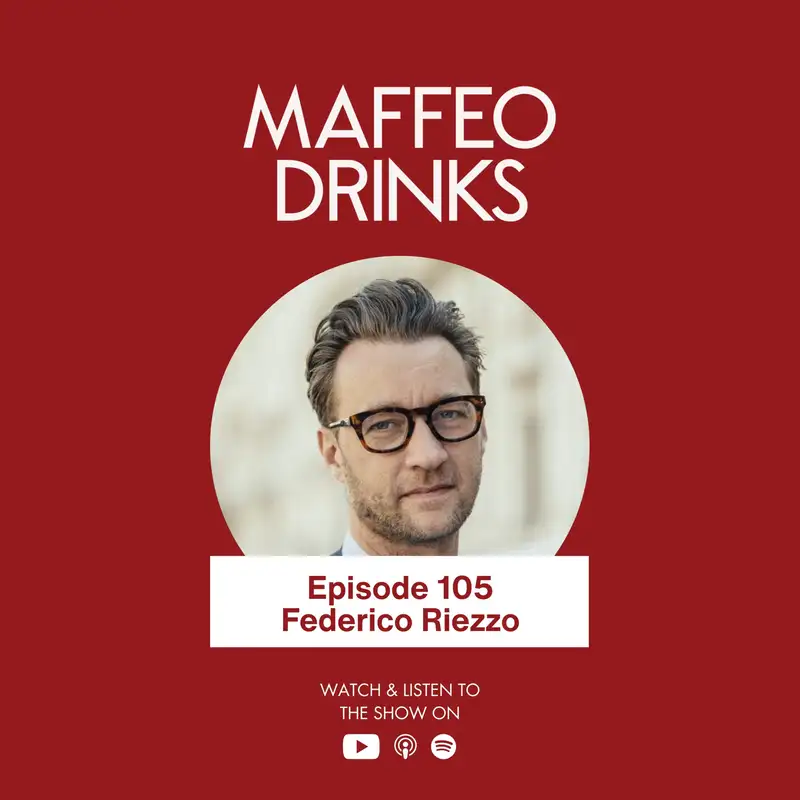
The Bar Under Their Palm: Federico Riezzo on London 90's Cocktail Golden Era and Why Service Beats Technical Skills | 105
Summary
In this episode, Chris Maffeo talks to Federico Riezzo, hospitality veteran and founder of Villa Mamo (a Villa in Tuscany), about London's cocktail renaissance and why human connection beats technical skills in bartending. Federico shares his experience at legendary London cocktail bars like The Pharmacy, Lab, Sketch, and Sanderson Hotel during the cocktail revival of the late 1990s and early 2000s. Learn how exceptional bartenders combined technical excellence with infectious energy to create welcoming environments that prioritize guest experience over complex mixology. Chris and Federico explore how service philosophy transforms bartenders into "gatekeepers of sales" through trust-building techniques like spirit sampling and storytelling. Discover practical hospitality strategies that create memorable bar experiences, generate customer loyalty, and drive organic word-of-mouth marketing in the cocktail industry. Perfect for bartenders, bar managers, hospitality professionals, cocktail enthusiasts, and anyone interested in London's cocktail history and modern bar service excellence. Timestamps 00:00 Introduction and Villa Mamo Overview 08:15 London Cocktail Renaissance Era 16:30 Service Philosophy vs Technical Skills 24:45 Trust-Building Through Sampling 32:20 Munich Bar Experience Example 37:46 Gatekeepers of Sales ConceptThis is Maffeiro Drinks.
Federico Riezzo:I remember the year on the year 2000 going to the lab in Soho. And my head was just blown. The quality of of the drinks, the quality of the staff, the design of the bar itself. But one thing that was an absolute game changer for me
Chris Maffeo:In this episode, I left the walls of the studio and went to the border of Tuscany and Umbria in in Italy to visit my good old friend, Federico Riezzo. When I visited Federico, right away, we started having a discussion about all things cocktail. We had a we had a drink down the road in a local bar, and we started talking. And then we said, hey. Hang on a second.
Chris Maffeo:Let's stop here. Let's go home, and let's record an episode. So this episode is a little bit a different one. In some bits, it feels like we're going a bit all over the place, but we actually don't. We have a pattern.
Chris Maffeo:We have a a fill rouge. So we start from how it was to work in the cocktail renaissance of the late nineties in London. He started at the pharmacy, the bar opened in the nineties by Damien Hirst back in Notting Hill in London. He has been working at Sketch. He's been working at the Sanderson.
Chris Maffeo:He's been working in many of the places that made the history. We talk about time that gave birth to many of the modern cocktails like the breakfast martini, the porn star martini, the penicillin, the difference between the approach that they were having back in the nineties, but also what is still valid.
Federico Riezzo:There's a lot of the places that try to become best 50. And to me, you know, the best 50 really is when when you give such a good customer service, oh, they don't care if this is, worth 50. Worth, it just made me feel amazing.
Chris Maffeo:We talk about bars that are guest first versus techniques first. We talk about how can we scale for brands, cocktail culture, and spirits culture in general. We spoke about so many things, and I don't want to spoil the the episode. So let's dive in now. Federigo, thanks for having me here in your beautiful Villa Mamo.
Chris Maffeo:Thank you. Welcome to the Maffodriggs podcast. Tell us a little bit about Villa Mamo and the concept behind it.
Federico Riezzo:Of course. So I I left Italy in '96. I was very young. I moved to London working in a very famous London bar called The Pharmacy, which was the very first art bar was defined by Damien Hirst to shrink twenty five years of history within twenty seconds. I moved to Ireland in 2012.
Federico Riezzo:I set up a successful event company. Was working with a globally known Italian brand, a beer brand, which Peroni. Peroni, thanks probably to you. That's how we met. I also collaborated with probably the biggest spirit company.
Federico Riezzo:I was designing cocktail lists for some of their brands whilst working with my bar based, cocktail based event company, me and my ex business partner, Kieran. I always wanted to do something back in Italy. And my wife is an interior designer, so we always wanted to renovate a farmhouse in Italy with the help of our best friends and business partner who are based in America. We found this place. I've looked at about twenty twenty properties around Tuscany, but didn't get the wow factor.
Federico Riezzo:And I walked into this space and I looked at the panorama, I looked at the actual space itself because it was such a blend of old, the house was built in 1786, but was done in a very modern style inside. And I'm actually getting a bit of goosebumps and it was like, oh my god, it's beautiful. So we just went in without any previous experience in renovation, with the help of some local guys and a lot of patients. We renovated this property, Guilamamo, within twelve, thirteen months. So it was a really long project because like everywhere, the workforce for like labor and job is really disappearing.
Federico Riezzo:A lot of young people don't follow these crafts anymore. And so it's been hard on that sense, but we were lucky that the house was incredible. It was really well refined, but there were a few things that we didn't want to change. So we changed five bathrooms, added two new bathroom mold, the electricals, a lot of the plumbing was done, so I think we did an amazing job.
Chris Maffeo:Fantastic, looks stunning. It's incredible place. I want to have these conversations because Andrew and I are longtime friends. 2013 we met in Dublin.
Federico Riezzo:It was 2013, wow.
Chris Maffeo:It was 2013 at the You Brewers Conference had bars, you worked in bars, now you work in hospitality, you had
Federico Riezzo:an An event event company. Was hosting a very big celebrity in Ireland. I'm not going to say who. But yes, my family had a coffee shop back in my little hometown. So really since I was nine or 10 years old I've always been in the bar learning how to make coffees.
Federico Riezzo:Sounds a bit of a cliche, but really that's how I was going. Like when I was finished school, I used to work in pizzerias because I studied a hotelier catering school here in Italy and to work as a chef in London, but I was just I didn't find my creative phone. I love service too much, like the only reason why I'm doing this is because I love service. The people interaction, making guests happy. My biggest goal is that when people leave, like, oh, we we met a new friend that we're probably not gonna see again, but we've got a new friend.
Federico Riezzo:I just love that human connection, and the bar is a great place for that energy because you get people from all walks of life. But we are still in the same place, so completely different, a bunch of unknown people, you're kind of principal magnetic force behind this environment. When you're really busy, you don't have time to talk to all the guests. So what I would normally would do, I would talk to a guest, but if I have twenty, fifteen drinks to make, it would be like, oh, you haven't met my great friend here, Frank. Frank, here's here's Robert.
Federico Riezzo:It's like, oh, well, could they can lend them to themselves to talk so you can talk to other people. Every now and then, how are guys doing? You also have to be conscious at a bot to work
Chris Maffeo:in some operation.
Federico Riezzo:Just talking together. The fantastic
Chris Maffeo:thing with you is that I remember when we had our honeymoon, not you and I, but with me and my wife, you know, like, I called you and then you hooked me up with people in LA, Vegas, San Francisco, all over the place, Melbourne. It's one of those things that is beautiful is the fact that you're exchanging phone numbers or nowadays Instagram accounts, and you have in the back of your mind that you may not see that person anymore, but at the same time there is this bonding connection and also then you never know when that's going to happen again. We met last time in 2018, but we've been in touch ever since, you know, we had events with Peron in Finland, all over the place, Barcelona Absolutely. And and it's it's that kind of not knowing, but at the same time connecting. That's in a nutshell what I call the drinks ecosystem and the hospitality ecosystem that actually connects all people together in a way that makes sense.
Chris Maffeo:And that's ultimately the thing. Like, it has to make sense for people, whether it's brands, bars, hotels Sure. Houses like this one. If it makes sense for everyone, then that's the win win situation because we always talk about successful brands, successful companies. That's ultimately for me, it has to make sense for all the artists involved.
Chris Maffeo:When it does, that's Yeah, a
Federico Riezzo:absolutely. I can tell you something, Like, you know, we've collaborated a lot, both industrial drinks making scenarios as well as talking about, you know, how brands develop. It's something that really stand behind. Of course, you have to have some quality in your products, which nowadays is very hard to find, you know, shitty products. Can I say shitty?
Chris Maffeo:Yes. Absolutely.
Federico Riezzo:Hope it's done now. Absolutely. But I do feel that people in the front of our house, whether it's the bartender or the waiter or the restaurant manager, when you establish a connection with your guests, you can really, you know, be the gatekeeper of sale. You can sell them everything. If you have got their trust and you're not there trying to screw them up, trying to, you know, they want a bottle of wine for €30 you want to sell them one for €150 If you say like, look, there is this one which is really good, but if you have a quality product that it makes sense for the occasion I'm actually getting goosebumps talking about this, because I feel this is so true You know, you can virtually sell them anything.
Federico Riezzo:Again, it needs to be boundaries of like what they're having, what's the occasion, what are their expectations for the nights and so on. But in that case, that's what I love about cocktails. If you can make something bespoke to them, which is not on the list, create something bespoke for the guy, 99% of the time, I was like, oh my god. This is amazing. Like, he made it just for me.
Federico Riezzo:And it's just something so beautiful that imagine going to a bar and you connect with the bartender or the waiter and they do something just for you. And you can use any brands you want, any brands you have really do you think they're gonna be working with the drinks or because you've got some advantages? Because sometimes there is, you know, if I have to use one vodka from the vodka regime from the gene, if there are some benefits, because sometimes there are also, you know, and again, going back to the discourse that you're not selling anything but it's just the low quality. There's just very similarities nowadays with the Absolutely, yeah. So again, going back to the discourse that you really are the gatekeeper for sale, but also to give a great service because you're giving something really bespoke to guests, which I think is amazing.
Federico Riezzo:When was the last time, well, for you it's slightly different because everybody knows you on the drinks scene, but when was the time you went to a place that people didn't know you and they gave you that kind of service?
Chris Maffeo:But I mean, then again, like I come from the beer world and then actually you were one of the gatekeepers that let me in the spirits side of things. And I remember like a couple of years ago, back to 2021, now it's like four years ago, I didn't know any single person in spirits. Okay. Zero. You know?
Chris Maffeo:So I came and I think that's what I bring and I try to contribute to the industry is the fact that I am an outsider and I'm bringing I'm not a spirits drinker since I was 18, you know? Like, I developed myself in the palate, so I am challenging in the sense of, so what? You are telling me all this nice beautiful story about the brand, but you have been working maybe for ten years, fifteen years on that brand and I want to bring a different perspective. Okay. Is this really different than this other brand or not?
Chris Maffeo:You know? Sure. You started in London in the heydays of cocktail culture, what they called the London Cocktail Renaissance. Yeah.
Federico Riezzo:Called in Iraq. Yeah.
Chris Maffeo:And one of the things that the Mafurgeons podcast tries to do is not losing knowledge. No? That's the the history, the legacy of my great grandfather, my grandfather that sort of went lost and I'm trying to keep alive, at least in memory. And there is this thing, and I was reading books about it. There's a beautiful book from Robert Simonson about this.
Chris Maffeo:The the fact that the craft spirits culture in The US and the Renaissance there moved to London, and it reignited the London cocktail scene back in, what was it, like, early two thousand?
Federico Riezzo:2000, like, '98, '96 onwards.
Chris Maffeo:How tell me without getting too nostalgic,
Federico Riezzo:but what what without getting started to cry. Well, to be honest, on that, I was a little bit late because, as I said, I arrived in London in '96, and I worked in the kitchen for a few years. Then in '99, I did a cocktail course with Bazian, who was like a bit of a legend. Salvatore Calabrese, Didardorelli, they were like the big shots. And obviously, there were the people at LAB, like Douglas Ankara, the people at the Match Group.
Chris Maffeo:So why'd you say you were late? Because you started
Federico Riezzo:in I were late because I started working. I started in kitchen and then around my first cocktail job was 1999 for Richard Branson's place in London. It wasn't a great cocktail bar. But then I moved to the pharmacy, was really cool. Big wigs were coming in and great DJs, great nights.
Federico Riezzo:But it wasn't considered as one of the greatest cocktail bar back then. But I I remember the around the year 2000 going to the lab in Soho, and my head was just blown. The quality of of the drinks, the quality of the staff, the design of the bar itself. But one thing that was an absolute game changer for me, it it was the speed of the bartenders, the quality of the drinks, and what I didn't see before for that caliber of cocktail bar was the energy and vibe that they're producing the bar stuff. Like, they they had the whole room under their palm.
Federico Riezzo:They knew everybody was shouting. In the meantime, sure they need hundreds of drinks an hour, but at a and they were all, like, perfect. I was like, oh my god. To me it was like the, you call it the apex of But like, hostel I then moved to another few other great places. I worked in Momo, I had this little stint in Sketch, I was working with Sanderson for a couple of years, then I went traveling.
Federico Riezzo:But it was a golden year. Again, Chris, going back to what we were saying yesterday or earlier this morning.
Chris Maffeo:She feels like we've been together for a year, but it's less than twenty four hours.
Federico Riezzo:I know. But there's a lot of emphasis now on the finished product when you go on cocktail bar. It's a lot of, you know, the way it was extracted, the rotovap, all these techniques which are great, think it's amazing. But again, what I was saying about the lab is just the vibe. You walked in and it was like, hey, guys.
Federico Riezzo:How are doing? It just felt like such a friendly, lovely place, but the quality of the drinks were stunning and it was all about the buzz and the customer service and that's what I think it's a little bit lost at the moment, as a lot of the places are trying to become best 50 and when you give such a good customer service they go, I don't care if this is like the worst 50 or if they just made me feel amazing, made me drink and they made me smile, and they remembered my name, and they introduced me to people. This legacy of this feeling that is a bit lost or maybe a little diluted at the moment. Sometimes it feels a bit mechanic as well.
Chris Maffeo:We were discussing yesterday that you were working in kitchens bringing a different kind of knowledge set. No? For sure. Bartending whenever I've I've tasted your drinks. There's always this kind of, like, chef component on A 100%.
Chris Maffeo:It. But what was it like coming in from making food instead of making drinks? Yeah. Because yesterday, you were mentioning, for example, the fresh juices. There was a bit of a rediscovery of the basics, if I understood correctly.
Federico Riezzo:100. Yeah. First of all, it was, like, pivotal moment in my life. I was blanching some vegetables, and I needed ice. And I was just it was really hot in the kitchen.
Federico Riezzo:It was like a crappy little Italian restaurant. I saw the head chef, I found my case, know everybody's case. And I remember walking to the bar, and I walked out. There was a bartender flirting with two beautiful girls, and I just came back, and I saw this, like, this head chef screaming at me. I was like, hold on a second here.
Federico Riezzo:Maybe there's a way out. So I was like, okay. So did another couple of months, I left the kitchen forever except for a few events I did for my own company. To me, it's always been about the ingredients. I remember the few bars at a war, they were buying syrups ready made, they were buying a lot of purest ready made, there was a lot of waste into that packaging, the cost and the personal footprint that you would leave on the product.
Federico Riezzo:When you make your own syrup, you make your sugar syrup, you add a bit of vanilla, add a bit of an orange skin or whatever to give that extra flavor, you know. So that was for me a great transition.
Chris Maffeo:So that was starting during those years?
Federico Riezzo:Correct. So I always started doing like, okay, I can do this myself. I can do it better. You know? So we were trying to play with cordial, with liquors and everything.
Federico Riezzo:I brought that sense of cooking and Italianness from the kitchen to the bar, which I still do nowadays. Everything that I do for Villa Mam, all the prep, cocktails, all of the products that are used, there's a bit of intervention by me, whether it's the gin and I add something on, or there is the liquor that I make myself for the cordials and syrups that I make myself for the cocktails that we give here at Villamanc for the use. What
Chris Maffeo:I feel at the moment is that there is a bit of a gap between that world of let's call it 50 best. I don't wanna pick on the 50 best, but just to get an idea of the the best bars in the world, the prestige bars or however wanna call it. And that place we went to down the road, you know, yesterday when we went to buy grocery. Old man, playing cards, sipping beer, sprites. No, it's all negroes.
Federico Riezzo:Sprites went around.
Chris Maffeo:Oh. And there's a gap in the middle, and I was discussing this with Francois Monti in a previous episode. The Serie B, the the the first division, the second division of Correct. Of cocktail. Because I think from when I try to look at it from a drinks ecosystem perspective, there is a the drinks and the hospitality ecosystem, the two sides of a coin.
Chris Maffeo:We need to make that coin play and and pay for bills. How do we scale that? Because the brands need scale because they cannot just function on the
Federico Riezzo:Yeah.
Chris Maffeo:On the top of the top, but then they want to ensure an experience down the pyramid, bottom I of the think
Federico Riezzo:that, at least talking from a person that was going to open a bar in Ireland compared to the places like The States, to open a bar is so much easier in The United States than it is in places like probably UK and Ireland. You know, the life especially in Ireland, the licensing is so difficult. So it's either the pub that makes cocktails or you get a really good cocktail bar. But the likes of Dublin you can only count, you know, 10 just cocktail bar that they make really good drinks, you know, for a big drinking country, you know? There is not that space.
Federico Riezzo:And I don't know if it's the same in Italy, but again, as you said, it's either you get your coffee, your beer, your pizza, your spritz, maybe your Negroni all in one place, or you go to the really top end places. So I don't know whether it's maybe there is not enough of a demand for that thing. I'm not sure I'll I'll be able to answer you that. I just think that also put more
Chris Maffeo:because I mean, you mentioned The US. And, I mean, US, like, the shocking thing in The US for any European or, let's say, non American is the fact that in The US, cocktails is everywhere. You know? You go to a very basic place. There's margaritas.
Chris Maffeo:There's cocktails.
Federico Riezzo:Long Valentine's tea. Yeah.
Chris Maffeo:And and it goes back in one of the previous episodes with with Christa Schubert with different cities at the Margarita cities, the Gironi cities
Federico Riezzo:Okay.
Chris Maffeo:Manhattan cities. And cocktail culture is widespread, and it's made easy in the sense that they don't overdo it. No? But I see it myself and, you know, with friends that are coming from a known, let's say, known spirits world, they are sort of scared. They come for dinner at some at my place, and I say, like, should we have a cocktail?
Chris Maffeo:You know, they look at me like if I'm gonna attack them. You know? You know? It's just like, no. No.
Chris Maffeo:No. No. They or, like, we if I mentioned whiskey, it's like, no. Whiskey. No.
Chris Maffeo:No. No. You know? There is a bit of a stigma on that. Aperol Spritz or, like, you know, the or the the the, you know, the Campari's of the world.
Chris Maffeo:You know? They try to ease up the thing, the gin and tonics.
Federico Riezzo:Yeah. Try now Paloma on
Chris Maffeo:on on Seguilla is trying to build that. But I feel there is still a gap between the beautifully crafted ice that cost €1 Yeah.
Federico Riezzo:Just just want to be
Chris Maffeo:bar two top down the road, and, know, you get three
Federico Riezzo:Three ice cubes.
Chris Maffeo:Three ice cubes.
Federico Riezzo:Well, it's a funny thing because obviously when my friends were coming over for dinner, was like, Fred is gonna make a couple of happy days. Were coming with that purpose. What the spritz in general have done is because first of all, they brought down the alcoholic ABV, right? So people would just enjoy, like we've done in Italy for, I wouldn't say centuries, but okay, right? Also has eased up the idea of having a cocktail, do you know what I mean?
Federico Riezzo:Cottonwood felt like it's a boozy thing, right? So what I love about the Aperol Spritz ideas is the fact that it really brought conviviality, the aperitivo time, which is amazing. Know, the people go out and they can have two Spritz and then go and do their things. It's not like a session thing. Also what I love, because I think it was kind of the catalyst of bringing bitter flavor into the real of people's taste.
Federico Riezzo:Because there was a lot of sweet and sour drink, the cosmopolitan, the Mojito, the Daiquiri and so on. There wasn't that many bitter drinks. I think what Aperol, Aperol Spritz did brought different facets of flavors to the mass.
Chris Maffeo:That's true. Which actually you raise a good point because it's actually why I haven't entered, let's say, the cocktail world earlier. Because I I don't like citrus. I don't like this sweet and sour kind of combinations. So I'm more of a, you know, the Negroni, the bourdier.
Chris Maffeo:Everybody knows it on the podcast because I'm always mentioning that. But the that was the moment of the Italian bartenders all around the world. That that's the mission Yeah. In life of bringing bitterness
Federico Riezzo:Bitterness to us. To but I I feel that if you look at, you know, unless you're going to dance some cocktails back then, you look at the big players of the year 2000 and so on, the Pornstar Martini, they're always, most of them were playing on this sweet and sour balance. If you look at the amount of just bitters in general over the last fifteen years, it's been maybe ten years. Just ridiculous. Like, now, I'm not trying to to make a differentiation between men and women, but now we can see a lot of women drinking Negronis, which I never served a Negroni in my life to a lady, if I'm without making any Yeah.
Chris Maffeo:No. No. No. And that's but this is also part of bringing scale to cocktail culture to demystify certain things. Because one of the topics that I'm always discussing is about removing the demographics and always putting the focus on the occasion.
Chris Maffeo:Oh, that's I'm always I'm always talking about the occasion because for me, it's if I'm out with my wife in this kind of weather, you know, 35 plus, I'm gonna go for the Spritz. I mean, yesterday we had a Spritz. We we had it like fifty fifty Campari Aperol. I wouldn't have had any groni. No.
Chris Maffeo:We were walking to the shop to buy some grocery. But at the same time, there is this thing that we need to acknowledge the fact that I discussed a little bit for brands trying to talk about Gen Z and younger, legal drinking age consumers. Some of these people, they don't have that palate yet.
Federico Riezzo:Well, I think they don't have the palate because, again, going back to the discourse where we started off the podcast, there is a lack of trust from the bartender to the consumer. Your wife was like, what should I drink? Like, I've got this bottle of Martini from the 1980s, and I made her a Vermouth and Tonic. And she was like, oh my god, it's delicious. It's an absolute whopper of a drink.
Federico Riezzo:You know? And I think my wife always drink both tonics, low ABV, you get the bitter flavors, you go more aromatic than gin and tonics, a lot more into that. And she absolutely love it. It's so refreshing and it's just, you know, fantastic. But if I wouldn't have proposed it to her, and what I've done to plenty of her friends, plenty of my friends that came over for dinner, instead of giving me like a gin and tonic, or a sprites, or whatever, it's like try Vermouth and tonic, they were like, wow.
Federico Riezzo:And she established a relationship. If he comes to my bar, he's like, Hey, Fadi, hi Chris. Hey, Fadi, I feel like a gin and tonic. Chris, can I you trust me just for one drink and if you don't like it, I'll buy it for you? Can I make you vermouth and tonic?
Federico Riezzo:Beautiful, fresh orange or fresh plant, a bit of oregano, bit of black pepper. You tell the story, it's a loy bevy that has a lot of beautiful flavors. You can have probably an extra one because it's only like 16% alcohol as opposed to 40% or 42% of gin. You have that customer in your hand because you're not trying to monetize often. You want them to come back, you want them to tell their friends, Oh, let's go and see Fade is at the bar, because that's what happened in the bar there at work.
Federico Riezzo:I'm not the best mixologist, I'm probably one of the worst. Well, I'm alright, I guess. But what I love is the fact that I've always established a relationship with the guests, whether I know them for years or not, because they're coming into my house. When you walk through that door, you're in my house, and you're my guest. Eventually, we'll create a bond, You'll fulfill my necessity with lending money.
Federico Riezzo:I feel the urge to serve. It's a privilege to be able to tell people and gain their trust by an achievement.
Chris Maffeo:There's something that you said that, you know, that the you you you you talk about trust. No? And I think there there's an element, which is the the lack of knowledge from a consumer perspective. I'm not picking on them. Just like stating what I feel like listening to you is like, there's a lack of knowledge with with my friends and myself in the past.
Chris Maffeo:You know, Vermouth, what is it?
Federico Riezzo:Absolutely.
Chris Maffeo:Beet whiskey, what is it? Single malt, what does it actually mean? You know, I heard it many times, but what does it actually mean? Sure. Trust because the the the fact that, you know, I'm scared that think it's more or less I know the price back bracket there.
Chris Maffeo:Yeah. And if he starts to take this crazy scotch whiskey No.
Federico Riezzo:Absolutely.
Chris Maffeo:I'm gonna go the rabbit hole, and Yeah. I don't know what's happening. And then the the the other thing is listening from a bartender perspective. Because we talk a lot about, you know, speedality. I say, because I've I've tried bartending, but you don't wanna see me bartending.
Chris Maffeo:I'm I'm the chatty guy, but then somebody has to make the drinks. It's about being able to listen because this too often when I go out, and I go out quite quite often, you know, the bartender is assuming too quickly what I like. You
Federico Riezzo:know? Okay.
Chris Maffeo:Automatically, there's there's this kind of like profiling. Okay. I'm Italian, so I like certain I, you know, I said, I mentioned whiskey and okay, I know what you're gonna yeah? And I don't wanna say 90%, but probably like 70% of the time they get it wrong. Sure.
Chris Maffeo:You know, because automatically there is this citrusy notes that I don't want. Right. There is a cranberry that I don't want. There is always something that I want. If they let me explain a little bit better what do I like, then I would really trust them because then it would be like every time I go to this guy or girl and I start to say, what do I feel like?
Chris Maffeo:They really nail it.
Federico Riezzo:Right.
Chris Maffeo:And I if I and I'm part of the industry, I'm more forgiving. Can imagine a consumer, 99% of time, I mean, if I take Prague, is going for a beer. Okay. That day that it's in the mood and I say, you know what? I'm gonna trust Chris and I'm gonna go for a cocktail with him.
Chris Maffeo:And if that bartender doesn't deliver on the experience, it's gone. It's gone. He's gonna try cocktails in five
Federico Riezzo:years There's time one thing that I always done at the bar, of course, depending by, you know, how busy we wear, because you can do this for everybody. Usually you tend to do it in the beginning of the night. And it's putting the ball in their court. So come to the bar and you want a gin and tonic and I don't know you, I'm not going to say, do you have a vermouth and tonic? You'll be like, shut up.
Federico Riezzo:Who are you? Like, I just arrived here. I want a gin and tonic. Give me gin and tonic, of course. But what I'll do, I will lead through a bit of a journey.
Federico Riezzo:So for example, if you are ex gin consumer, but I can propose something else, like what other sort of botanicals do you like? What what other fruit do you like? Because we can start playing the garnishes and sort of take them through a bit of journey with trying different grains, again, to gain their trust, establish a relationship for a possible returning customer x returning income. One thing I always did is to have a lot of shot glasses at bar and let them sample a little bit oxygen. So let's say you have ten, twelve gs in your back bottle, 15 or whatever.
Federico Riezzo:But they go for a certain type of drink, very fresh. It gives them like, why don't you try this one? Just like five ml doesn't cost anything to the barstool. But what it gives, what it does cost, but in the bigger picture it really gives people a completely different experience. Like you're going from a gin tonic to almost a gin master class or a gin And it just changes the evening.
Federico Riezzo:Looking at it from the market perspective, you can probably sell them more expensive jeans there, but you're not going through, I want X jeans that cost €10 and you're like, oh, try this jeans and it's like €18 No, will lead them through. What you've done, you have established trust channel, you know, because you don't want to rip them off in any way. Of course, you want them to spend money, remember the experience, I'm back. But what you do in terms of the brand build bottom up, I think, you know, there is a big thing to say about bartender server front of us, because if you have, like I know this for a fact, because sometimes there are branders like if you sell 20 cases of this wine or 20 cases or 12 cases of this spirits, win a trip in there, you know. And within the three weeks, somebody would have sold everything because, you know, that was a Porsche that was artificial, But, that kind of shows you the power, the power staff, the bartenders, the house
Chris Maffeo:manager. Feel free to challenge me on on that one. Like, I like to to dissect a spirit or any category. Let's take vermouth as an example or or gin. Like, is the the wine element, the botanical element, and if you take gin on on vermouth and then on gin, there is also, again, like, the botanical element mainly.
Federico Riezzo:Yeah.
Chris Maffeo:And then there's juniper. You don't like juniper or you like juniper. Is it juniper forward or or it isn't? And if you dissect that, then you can have that kind of conversation with the guest because then all of a sudden, it's like, oh, I like vermouth. And it's like, okay.
Chris Maffeo:But what does he like about vermouth? Does he like the wine? Do you like elementals? Does he like the botanio? Because if if then all of a sudden it's like, I usually drink gin and tonics and Negroni.
Chris Maffeo:Maybe it's gonna be botanicals, but let me double check it. And you ask another question, and then it seems like you like botanicals. Yeah. And that's like,
Federico Riezzo:oh, I never thought
Chris Maffeo:about it. Actually, yeah.
Federico Riezzo:It's true.
Chris Maffeo:Then you can have that conversation, and it's leading you somewhere.
Federico Riezzo:For sure.
Chris Maffeo:But there is too often these assumptions, which is leaning to the other point, which is as bartenders, and again, I'm I don't wanna pick on bartenders because I'm not part of this audience, but it's like leaving a bit on the in the bubble. And if you don't leave the bubble, we cannot scale cocktail culture.
Federico Riezzo:What do you mean for the bubble?
Chris Maffeo:The knowledge bubble. Because if I'm I'm talking to imagine this example today, you know, tonight we're gonna go out and it's me and Jude that are quite familiar with spirits Yeah. And then our wives. And then they are less familiar than us. And then if we start to play cool, and obviously, you your knowledge is much more developed than my knowledge
Federico Riezzo:Yeah.
Chris Maffeo:Then all of a sudden, like, you lose them. And I when I go out with my wife, for example, I go to the best cocktail bars in Prague or Bratislava, high five the bartender. And then the moment they start talking to my wife, they talk like they talk to me. You know, this is citrusy forward. This is like a spirit forward cocktail.
Chris Maffeo:So and she looks at me like, what the hell is this guy talking about? Sure. Citrus forward. What the all this terminology can be like that. Absolutely.
Chris Maffeo:You know, only like one or 25% of the people, even like a person working in logistics in a spirits company will not understand what he's talking about. So if we don't leave the bubble of terminology, of super refined palate.
Federico Riezzo:That's exactly.
Chris Maffeo:We're never gonna scale that, which is what going back in full circle to the to the Spritz example. That's what they managed
Federico Riezzo:to do. Absolutely. And what I think goes back to what I was saying is also because no matter how developed or underdeveloped your taste buds are, you're still gonna taste something, right? So that's why it is not scalable for all places, because some people, you know, they really are high volume bars, so you can't just give a little sample to everybody. For example, let's say I talk to you about one spirit with all the complicated, professional terminology, I talk to your wife and you have to read the situation as well as a bartender, you know, but in that case I put again two small sample and no matter what I use, I can speak about an hour about this brand and another hour about the other brand, you will try the things like, oh, I much prefer A compared to B.
Federico Riezzo:And if I'll make a drink with A, well, how is it? You can't say, oh, it's bad, because he kind of chosen it. So you'd be like, oh, it's amazing, thank you very much. So already the do you see what I mean? The experience has changed.
Federico Riezzo:The moment that you've created this cohesion, this narrative between you and the guest, it's already like, I'm gonna have a great night here. And I'm gonna be like, I'm gonna sell whatever you want and make me very happy. Of course, I'm not, when I say whatever you want, I'm not gonna sell, I'm not gonna sell the polar bear or like, you know, petrol, so very expensive stuff. But we're gonna go on a journey where you're gonna discover new things that you will like because we've been working alongside each other. We'll go for a little journey.
Federico Riezzo:Chris, sometimes I had people come in at six, you know, when the bar would open and leave in at eleven. That's a five hours thing. Like, obviously, a lot of glasses of water in between, but they spent some serious money there. And you know, that that was a great night. Like, I've learned.
Federico Riezzo:I almost like made my own drinks at the end of it all, know, mandarin juice with a squeeze of this and that. So I think there's a lot to say going back to these courses for bartenders, it's just to establish this connection and, you know, if we've got to back up good quality brands behind you, sales are really, really clearly visible there.
Chris Maffeo:And you made you made me think like actually with my wife when when we went to Munich for one night, two years ago because I was having the last round of an interview for a big company. Didn't get the job by the way. And I went to Munich. We studied the German marketing with the interviews. So I sit some bars and so on.
Chris Maffeo:So we go to a restaurant for lunch. Then we go for coffee at Barcentrale. It was in a place in Munich. It was just a small cafe with, it was winter, January, and it's no outside, you know Dark gray. Yeah.
Chris Maffeo:Crazy weather. And then we go in, and there's there's one of these curtains not to get the the cool you know, the the cold get in. We didn't know what was inside, but we go there to have a coffee, and then go to you know? And we enter, and it this is, like, 2PM Saturday. You know?
Chris Maffeo:They open the door, and then it's crazy inside. Wow. You know? They're packed. Okay.
Chris Maffeo:Seventies and eighties, like, Donatellare, like this side. Okay. You know? Loud seventies and eighties Italian music, Raffaella Carrai, you know, that kind of vibe. Yeah.
Chris Maffeo:Yeah. Loud. There's nowhere to sit. You know, we are trying to find big place? No.
Chris Maffeo:It's a it's a small I mean, it's one fourth of of this. Okay. And then we try to make our way to the bar to literally have two espressos, and and a short guy comes in with an iPad or whatever. And he's like, guys, two Spritz. And we we look at each other, and in a blink of a second, you know, the loud music pumping, you look around, and there's everybody having spritz and who goes and campfire.
Chris Maffeo:Yeah.
Federico Riezzo:You know? Like, so we You couldn't have said no. There was no way you would have said
Chris Maffeo:no. So we just like and in the moment of a second, like, we get two spritzes, you know, also, like, talking about service and so on. It gets crazy. You know? We start kinda, like, dancing at 3PM, you know, totally sober.
Chris Maffeo:Yeah. You know, started dancing. And we meet an older couple, German couple. We start buying rounds to each other. We we leave the place from two.
Chris Maffeo:We left at 8PM. That was what experience can give you
Federico Riezzo:For sure.
Chris Maffeo:And service. Because if if we had been waiting twenty minutes for Dead Spritz, that would have been the last one. We would have gone. If the music was not the right one, if other people were not consuming what we were consuming and all this kind of thing. No?
Chris Maffeo:That's all for today. I hope you enjoyed this episode with Federico Riezzo. You might have felt that we went a little bit off piste sometimes, but we managed to keep each other on track. He's been working in many of the places that made a history. He has been working in Australia, in New York.
Chris Maffeo:He was the cofounder of an event agency back in Dublin. In this episode, as well as in the others, there's so much knowledge that I always prepare a deep dive analysis that I share by email. So you can get that at mafeldrinks.com.
Federico Riezzo:There are
Chris Maffeo:free and paid plans monthly and yearly. If you can think of a couple of people that can benefit from this episode, please share it with them in video, on Spotify, on YouTube, and in audio, on Apple Podcasts, and all the other platforms. I'm sure that you have many friends that either didn't know about the nineties in London and want to know more, or they were actually part of it and they will enjoy going down memory lane and refresh some of their knowledge. That's all for today. And remember that brands are built bottom up.
Creators and Guests